LinkModel vs fal.ai comes down to pricing, model coverage, and deployment flexibility. LinkModel is a compelling option for developers seeking lower API costs on supported commercial text, image and video models. fal.ai is particularly strong in creative-model coverage, specialized endpoints, and custom Serverless GPU deployments. The better choice depends on which models your application actually needs.
API pricing becomes harder to compare when providers use different billing units, quality settings, and endpoint configurations. In this article's July 22, 2026 pricing snapshot, LinkModel offered substantially lower rates on selected Seedance 2.0, GPT Image 2, and Gemini image configurations. However, historical discounts should not be mistaken for guaranteed current savings. The real decision also depends on generation quality, concurrency, latency, and cost per successful output.
For teams looking to reduce commercial AI API spending without managing custom GPU infrastructure, LinkModel provides unified access to supported image, video, and language models. Its competitive pricing on selected endpoints makes it worth evaluating against fal.ai, especially for production applications where generation costs accumulate at scale. For a deeper breakdown of fal.ai's billing units, see our fal.ai pricing guide.
LinkModel vs fal.ai at a Glance
| Decision factor | fal.ai | LinkModel |
| Best for | Creative models, specialized inference, custom GPU deployments | Cost-conscious commercial text, image and video API workflows |
| Pricing | Endpoint-specific image, video, token and compute billing | Competitive model-specific pricing with supported native billing units |
| Seedance 2.0 | Standard 720p endpoint lists $0.3034/sec | Historical 720p equivalent: $0.13608/sec; reconfirm live rate |
| Model coverage | Extensive creative and open-source catalog | Curated commercial multimodal catalog |
| Custom deployment | Serverless GPU and custom inference | Unified managed model access; not a direct GPU-hosting equivalent |
| Concurrency | Documented account and endpoint limits | Confirm model-specific capacity and rate limits |
| Developer tools | SDKs, queues, schemas and deployment tooling | Unified API access, request tracking and generation workflows |
| Best decision | Choose for specialized infrastructure and model requirements | Evaluate for lower costs on matching supported models |
Bottom line: Start with the exact model and production workload. If both providers support your required endpoint, compare current prices and successful-output costs. If you need custom GPU deployment or specialized open-source inference, fal.ai offers capabilities that a commercial model gateway does not directly replace.
Four Production Trade-Offs to Compare
fal.ai offers extensive creative-model coverage, specialized developer tooling, and custom inference infrastructure. However, production teams should evaluate several operational considerations before committing to a provider: concurrency limits, prepaid-credit requirements, billing-unit differences, and error-related costs. These are documented platform characteristics rather than evidence that fal.ai is unreliable. For a broader assessment, see our fal.ai review.
1. Concurrency Starts Low and Scales with Credit Purchase History
fal.ai states that every new account starts with a global concurrency limit of two requests. The limit increases according to paid invoices from the previous four weeks and scales up to 40 for self-serve accounts. It applies across endpoints, and high-demand models may have additional endpoint-level limits.
Requests are not rejected when the concurrency limit is reached; they wait in the queue. That protects completion, but it also means production latency can rise before a team realizes that its account capacity is the bottleneck.
How LinkModel differs: LinkModel provides request tracking, usage visibility, and published reliability information for supported workflows. These features help developers monitor production requests, but they do not establish a directly comparable concurrency advantage over fal.ai. Before deploying at scale, confirm each provider's endpoint-specific rate limits, queue behavior, and available capacity under your account.
2. Prepaid Credits Influence Both Spend and Capacity
fal uses prepaid credits, and its pricing documentation says those credits fund both Model API usage and concurrency limits. For a growing product, increasing capacity may therefore involve buying more credits before the workload has consumed them.
How LinkModel differs: LinkModel emphasizes usage-based API access without a mandatory monthly platform subscription. This can be attractive to developers testing new products or scaling gradually. Before choosing either provider, compare any applicable credit requirements, account-specific limits, and payment terms alongside the actual model price.
3. One Platform Still Contains Several Billing Models
fal Model APIs may charge per image, megapixel, video second, video, request or compute second. This is transparent in the documentation and is not inherently a flaw. The pain appears in cost governance: finance and engineering must normalize different units before comparing models or attributing a margin to each feature.
For Seedance 2.0, fal’s per-second presentation is convenient but differs from the upstream output-token commercial unit. The conversion can hide the effective token markup unless the model, resolution and token density are held constant.
How LinkModel differs: For supported token-priced commercial models, LinkModel publishes model-specific rates that can be compared with the upstream provider's pricing. This helps developers estimate token-based costs without converting every request into an image or video equivalent. However, teams should still check the actual billing unit, model settings, and invoice records for each endpoint.
4. Client Errors Can Still Create Cost
fal’s FAQ says server errors are not charged. It also notes that client-side errors such as invalid inputs may still be charged if a runner spent GPU time before the error was detected. For applications that accept user prompts or files, validation quality can therefore affect cost.
How LinkModel differs: LinkModel documents authentication, request parameters, task states, and error responses for supported APIs. These features can simplify integration and troubleshooting, but they do not by themselves establish lower failure rates or more favorable error-billing policies. Developers should validate inputs before submission and test how both providers handle failed or interrupted requests.
Seedance 2.0 API Pricing: Token Rates vs Per-Second Costs
Seedance 2.0 pricing should be compared using the same model, endpoint, resolution, and output duration. fal.ai currently publishes a standard endpoint rate of $0.014 per 1,000 tokens for 480p, 720p, and 1080p generation. This is equivalent to $14.00 per million tokens.
LinkModel's July 22, 2026 comparison snapshot listed the following rates. These figures are historical and must be reconfirmed against the current model listing before being treated as live prices.
| Configuration | fal.ai published token rate | LinkModel historical token rate | Historical price difference |
|---|---|---|---|
| Seedance 2.0 480p | $14.00/M | $6.30/M | 55.0% |
| Seedance 2.0 720p | $14.00/M | $6.30/M | 55.0% |
| Seedance 2.0 1080p | $14.00/M | $6.93/M | 50.5% |
The percentage differences above compare published fal.ai token pricing with LinkModel's historical token rates, not two independently verified current invoices. The actual cost of a generation depends on output dimensions, duration, endpoint mode, and applicable input charges.
For the latest model availability and rates, check LinkModel's pricing page and the fal.ai Seedance 2.0 endpoint.
Seedance 2.0 Cost per Second: Standard vs Fast API Pricing
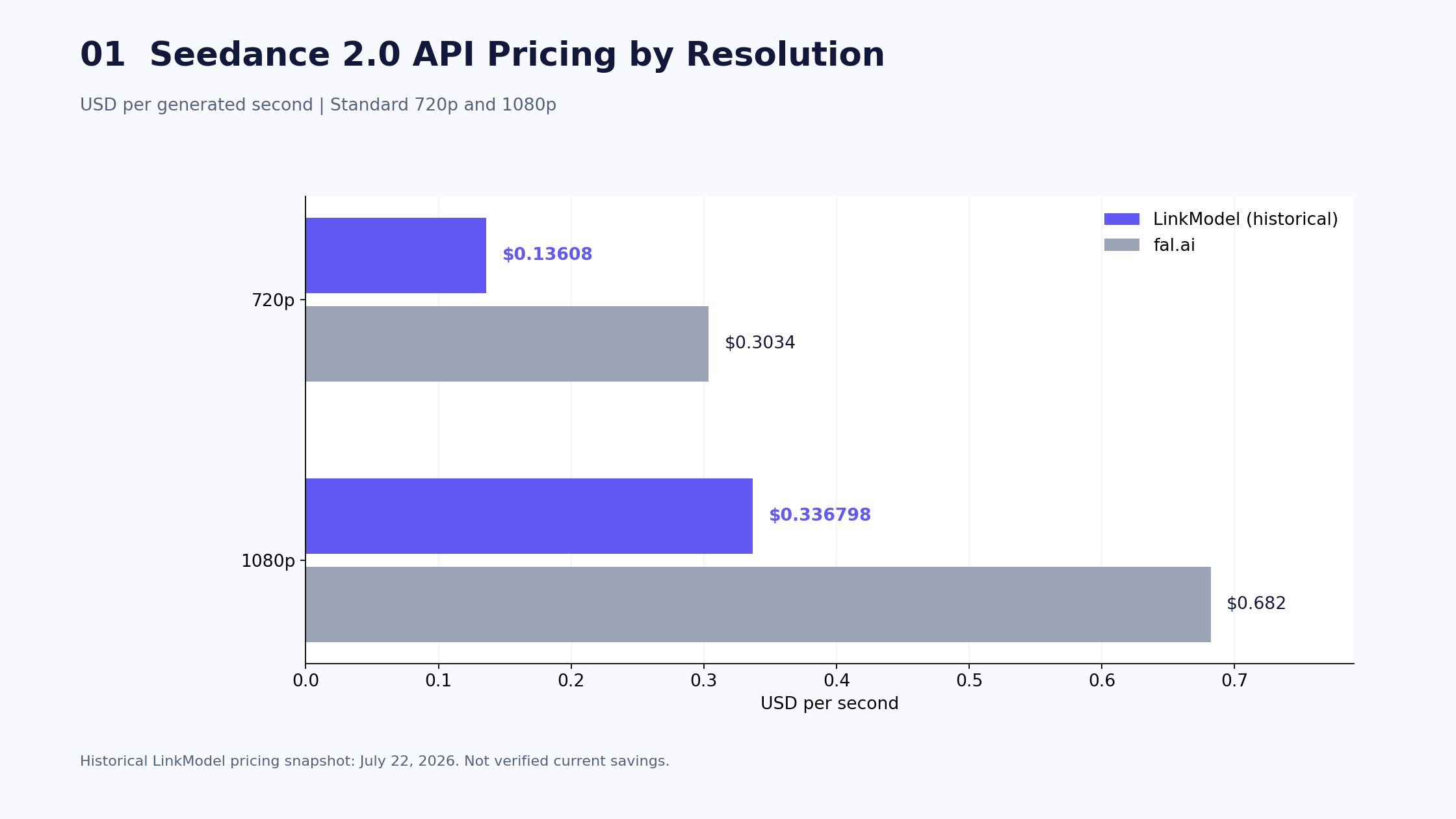
fal.ai's standard Seedance 2.0 endpoint currently lists $0.3034 per second for 720p and $0.682 per second for 1080p. Its 720p Fast endpoint lists $0.2419 per second, making endpoint selection important when comparing providers.
| Endpoint and resolution | fal.ai published rate | LinkModel historical equivalent | Comparison status |
|---|---|---|---|
| Standard 720p | $0.3034/sec | $0.13608/sec | Historical LinkModel rate |
| Standard 1080p | $0.682/sec | $0.336798/sec | Historical LinkModel rate |
| Fast 720p | $0.2419/sec | Not verified | Not directly comparable yet |
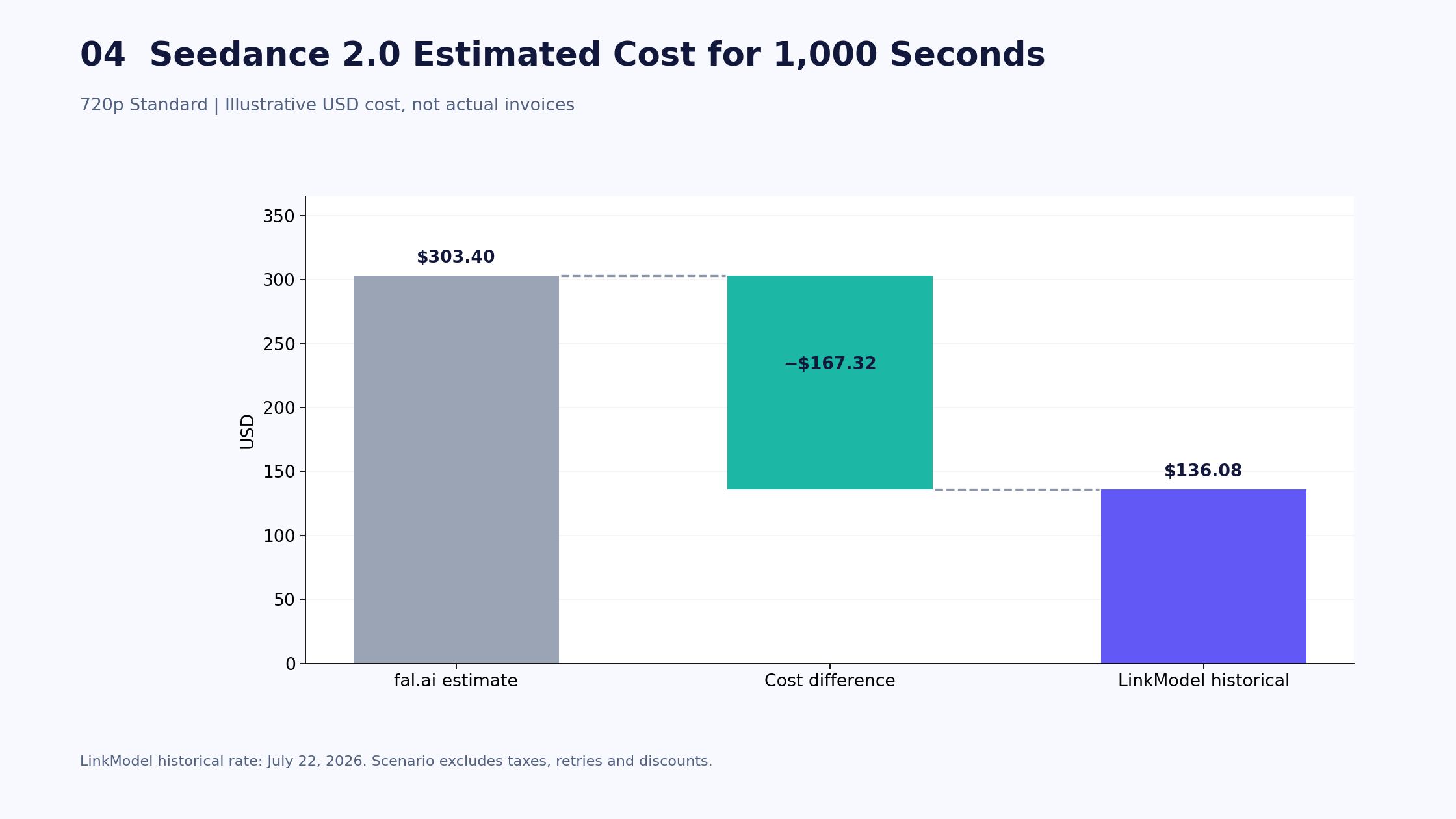
For example, 1,000 generated seconds at fal.ai's listed standard 720p rate would cost $303.40. Using LinkModel's historical $0.13608-per-second equivalent would produce an estimated cost of $136.08, a difference of $167.32. This is a pricing illustration, not a verified current production bill or guaranteed saving.
These estimates exclude taxes, retries, negotiated discounts, and any additional charges associated with the chosen workflow. Before making a purchasing decision, verify the current LinkModel endpoint price and compare matching generation modes.
GPT Image and Gemini API Pricing: Which Provider Costs Less?
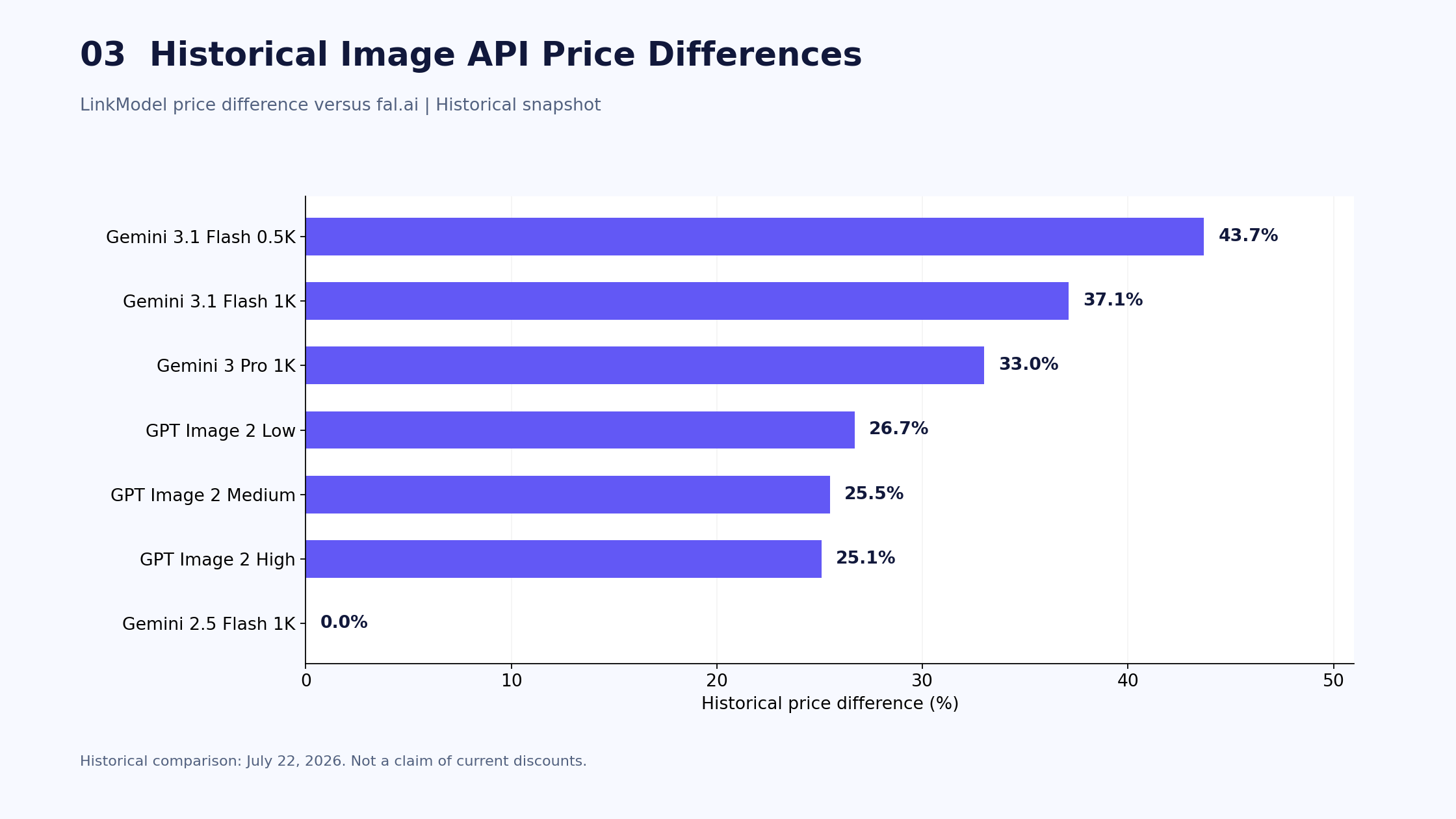
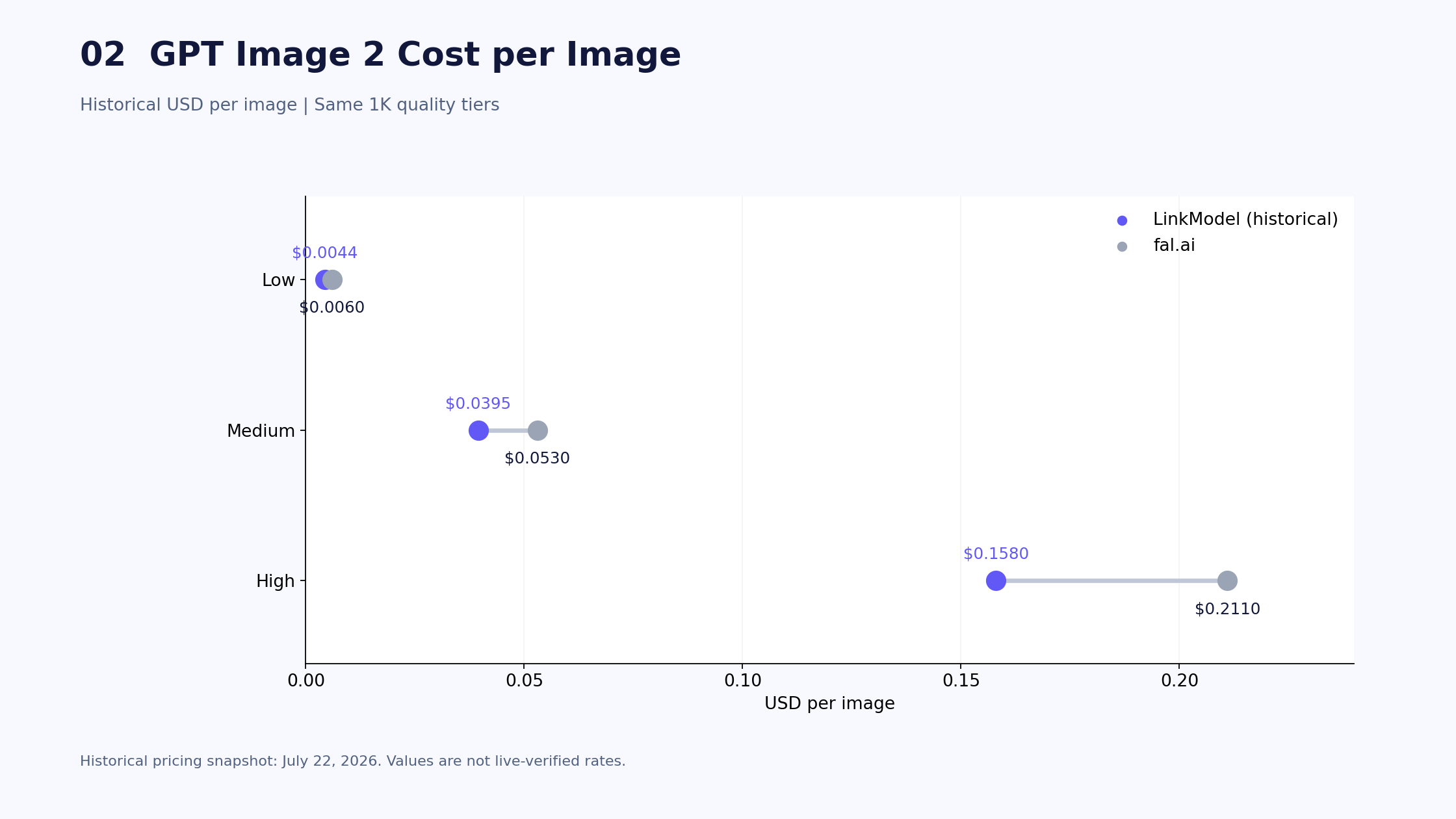
LinkModel's historical pricing shows advantages on several GPT Image and Gemini image-generation configurations, but the size of the discount varies by model and output quality. The table below preserves the July 22, 2026 comparison snapshot rather than presenting these figures as newly verified live prices.
| Model and configuration | fal.ai historical rate | LinkModel historical rate | Historical difference |
|---|---|---|---|
| GPT Image 2, 1K, low | $0.0060/image | $0.0044/image | 26.7% lower |
| GPT Image 2, 1K, medium | $0.0530/image | $0.0395/image | 25.5% lower |
| GPT Image 2, 1K, high | $0.2110/image | $0.1580/image | 25.1% lower |
| Gemini 3.1 Flash Image, 0.5K | $0.0600/image | $0.0338/image | 43.7% lower |
| Gemini 3.1 Flash Image, 1K | $0.0800/image | $0.0503/image | 37.1% lower |
| Gemini 3 Pro Image, 1K | $0.1500/image | $0.1005/image | 33.0% lower |
| Gemini 2.5 Flash Image, 1K | $0.0380/image | $0.0380/image | Same price |
Why this matters: Image-generation costs increase with production volume, especially when an application generates multiple candidates before accepting one. Even a modest difference per image can become meaningful at scale.
However, per-image prices are not interchangeable across different quality tiers, aspect ratios, input references, or model versions. For a reliable purchasing decision, compare the current prices for the exact settings your application uses.
Explore LinkModel's current model pricing before estimating production savings.
GPT Image 2 Token Pricing: Input, Cached Input, and Output
Token-based pricing helps explain why two GPT Image 2 requests can cost different amounts even when they use the same model.** Input text, reference images, cached content, and generated image output can have separate billing rates.
The following figures reproduce the July 22, 2026 pricing snapshot. They are not independently confirmed as current October 2026 rates.
| Token category | Official historical rate / 1M | LinkModel historical rate / 1M | Historical savings |
|---|---|---|---|
| Text input | $5.00 | $3.75 | 25.0% |
| Image input | $8.00 | $6.00 | 25.0% |
| Cached text input | $1.25 | $0.9375 | 25.0% |
| Cached image input | $2.00 | $1.50 | 25.0% |
| Image output | $30.00 | $22.50 | 25.0% |
The cached text input rate is shown at full precision rather than rounded to $0.94 per million tokens. This avoids understating the historical discount.
For production budgeting, check whether caching is supported and applicable to your actual requests. The total cost depends on the number of billable tokens, the model's image-generation settings, and the provider's current pricing rules.
Production Cost Comparison: What Could 1,000 Videos Seconds or 10,000 Images Cost?
Small differences in API pricing can become significant when generation volume increases. The following scenarios illustrate how the rates in this article's historical comparison affect estimated costs at different workloads.
| Example workload | fal.ai estimated cost | LinkModel historical estimate | Illustrative difference |
|---|---|---|---|
| 1,000 seconds, Seedance 2.0 Standard 720p | $303.40 | $136.08 | $167.32 |
| 1,000 seconds, Seedance 2.0 Standard 1080p | $682.00 | $336.80 | $345.20 |
| 10,000 GPT Image 2, 1K medium images | $530.00 | $395.00 | $135.00 |
| 10,000 Gemini 3.1 Flash Image, 1K | $800.00 | $503.00 | $297.00 |
| 10,000 Gemini 2.5 Flash Image, 1K | $380.00 | $380.00 | $0.00 |
Calculation method: Estimated cost = workload volume × the applicable per-image or per-second rate. These are illustrative workloads, not measured customer bills. The fal.ai Seedance Standard rates have been checked against its published endpoint pricing; the remaining comparison inputs include historical rates.
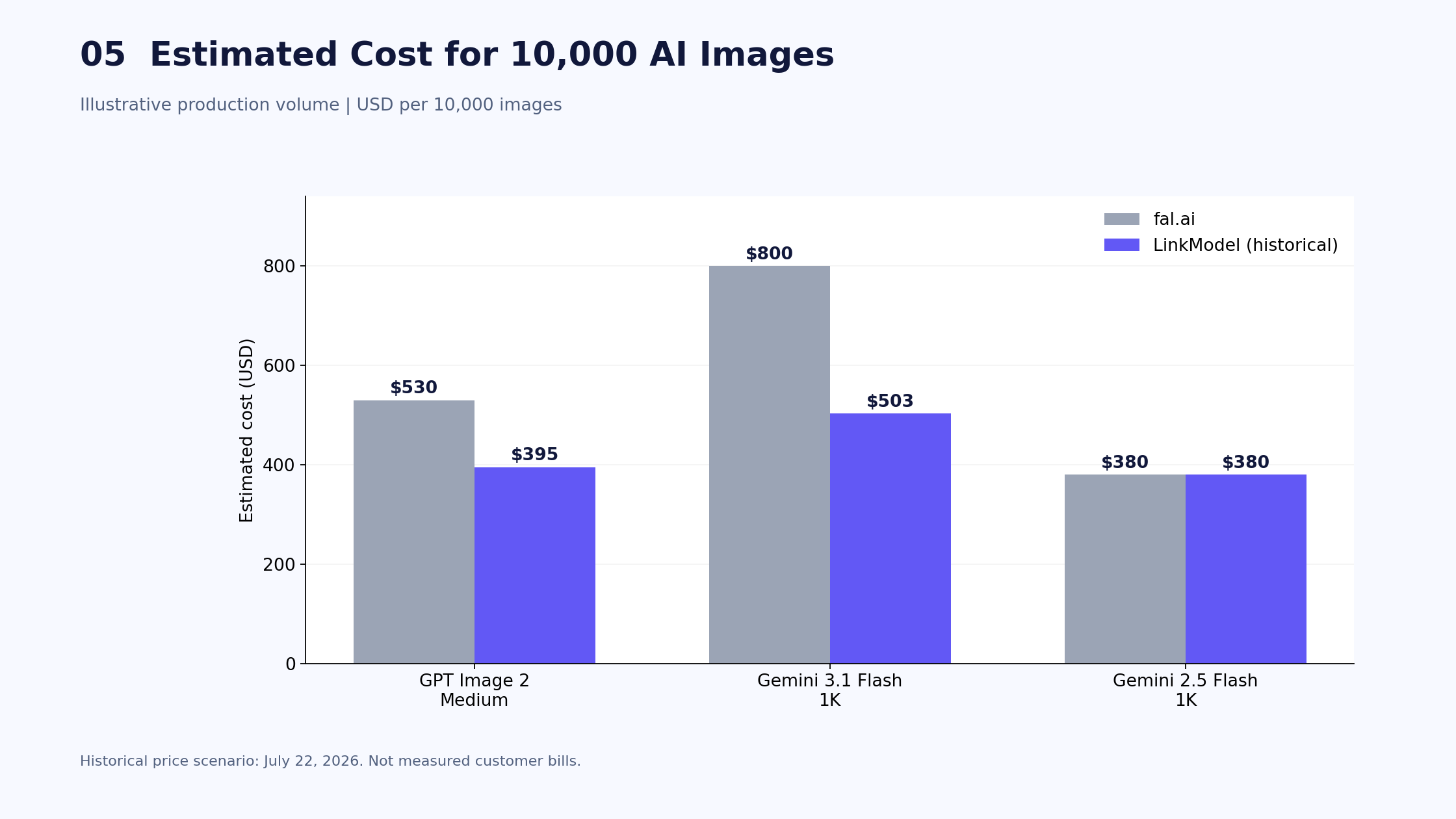
Actual production costs may differ because of retries, rejected outputs, varying request configurations, discounts, and taxes. For a more meaningful comparison, track cost per accepted output, not only cost per generation.
If your workload uses a fixed model and quality preset, check LinkModel's current pricing to estimate whether switching providers could reduce your spending.
Model Coverage: Commercial Breadth vs Open-Source Flexibility
The most useful distinction from the old article remains valid when stated carefully:
- fal.ai is especially strong for creative/open-source endpoints and custom Serverless deployments. Its model-specific schemas, SDKs and queue tooling are valuable when developers want control over specialized workflows.
- LinkModel is optimized around popular commercial text, image and video models. It offers OpenAI-compatible chat for supported models and one account for generation APIs such as GPT Image, Gemini Image, Seedance, Kling and Sora.
The old statement that fal.ai has no text models should not be repeated. Current fal pricing documentation explicitly mentions LLMs and other model types. The better buying question is whether the exact commercial models and operational controls your product needs are available under one account.
API Experience and Production Operations
fal.ai provides model-specific API schemas, SDKs, queue management, pricing information, and custom Serverless deployment capabilities. These features are valuable for developers building specialized creative AI products or managing their own inference workloads. However, integration requirements can vary across models and endpoint types.
LinkModel focuses on unified access to supported commercial AI models. Developers can use a single account and API credentials for supported text, image, and video workflows, reducing the need to manage separate provider accounts. Its generation APIs also support documented request and task-management patterns, although individual model parameters and asynchronous behavior should be checked before integration.
curl --request POST \
--url https://api.linkmodel.ai/v1/videos/generations \
--header 'Authorization: Bearer <YOUR_API_KEY>' \
--header 'Content-Type: application/json' \
--data '{
"model": "sora-2",
"prompt": "A golden retriever catching a frisbee in slow motion"
}'
For production deployments, developers should review each provider's current documentation for data retention, service reliability, error handling, rate limits, and failover behavior. fal.ai may be the better choice for teams requiring custom inference infrastructure, while LinkModel can offer a simpler purchasing and integration path for supported commercial models. Neither platform's documentation alone establishes superior real-world latency or reliability; those factors should be tested with the intended workload.
LinkModel vs fal.ai: Which Provider Should You Choose?
Choose LinkModel when lower costs on supported commercial AI models and unified multimodal access are your priorities. Choose fal.ai when your application depends on specialized creative models, custom GPU deployments, or model-specific inference tooling.
Choose LinkModel for Commercial AI Applications
LinkModel is worth evaluating when:
- You want to compare lower-cost routes for supported GPT Image, Gemini, Seedance, or other commercial models.
- Your application uses text, image, and video APIs and you prefer managing them through one account.
- You want to reduce the number of separate API provider integrations.
- Your production budget depends heavily on generation volume.
- You prefer a managed model API rather than deploying custom GPU infrastructure.
Best-fit example: A content-generation platform that produces large volumes of marketing images or short AI videos using a supported commercial model.
Choose fal.ai for Specialized Models and Infrastructure
fal.ai may be a better fit when:
- You need a specific creative or open-source model unavailable through LinkModel.
- You want to deploy or customize inference workloads using Serverless GPUs.
- Your application requires model-specific SDKs, queue tooling, or specialized parameters.
- Your team is comfortable managing endpoint-specific billing and concurrency.
- The exact fal.ai endpoint offers better pricing, performance, or functionality for your workload.
Best-fit example: A creative AI product that experiments with specialized open-source models or requires custom inference deployments.
Before Switching Providers
Evaluate the same model and request settings on both platforms. Compare output quality, latency, successful-generation costs, concurrency behavior, and error handling. Check that your existing request parameters and response-processing logic can be mapped to the new API.
For additional options beyond these two platforms, explore our fal.ai alternatives comparison.
Frequently Asked Questions
Is LinkModel cheaper than fal.ai?
For most Seedance 2.0, GPT Image 2 and Gemini configurations shown in the July 22, 2026 snapshot, yes. Gemini 2.5 Flash Image 1K is tied. Always compare the exact live endpoint and specification.
Are failed fal.ai requests charged?
Server errors are not charged. fal’s FAQ notes that some client errors may still incur a charge if GPU work occurred before the invalid request was detected.
Is fal.ai better for custom models?
Usually, yes. fal.ai’s Serverless platform and creative/open-source ecosystem are important advantages for custom or specialized deployments.
Is LinkModel better for commercial multimodal applications?
It can be. LinkModel focuses on popular commercial text, image and video models, supports one account and unified billing, and is lower on most configurations in this comparison.
Can I migrate from fal.ai without rebuilding my entire product?
Migration effort depends on the existing SDK, endpoint and request schema. LinkModel’s OpenAI-compatible chat and modality-level generation APIs can reduce provider-specific routing, but each model’s request fields should still be mapped and tested.
Final Verdict: Is LinkModel a Better Alternative to fal.ai?
LinkModel is a compelling fal.ai alternative for developers prioritizing lower API costs on supported commercial models and unified access to image, video, and language APIs. Its historical pricing advantages on selected Seedance, GPT Image, and Gemini configurations demonstrate why it deserves consideration, particularly for applications where generation costs scale with usage. fal.ai remains a strong choice for specialized creative models, custom Serverless GPU deployments, and advanced inference tooling.
The best provider ultimately depends on the exact model, current pricing, output quality, latency, and operational requirements. If your application already uses commercial models supported by LinkModel, compare current API pricing and evaluate the potential savings before committing to your next production deployment.