fal.ai pricing depends on whether you use hosted Model APIs or Serverless GPUs. Hosted models charge by images, video seconds, tokens, or other endpoint-specific units, while Serverless GPUs charge for billable runner time. Current GPU list rates range from $4.00 to $12.99 per GPU-hour, but those rates do not tell you what a hosted image or video generation will cost.
The challenge is predicting your actual production bill. Higher resolutions, retries, idle GPU capacity, and different billing units can turn a seemingly low rate into a much larger monthly expense. The most useful comparison is cost per accepted output under matching model settings, not simply the cheapest advertised price.
For developers who want lower model costs without managing GPU deployments, LinkModel offers a unified API for supported image, video, and language models. Its Seedance 2.0 pricing illustrates the potential savings: $0.13608 per generated second at 720p under the published no-video-input calculation, compared with fal.ai's approximately $0.3034-per-second displayed estimate. For more on fal's broader capabilities, see our fal.ai review.
fal.ai Pricing at a Glance
fal.ai has two main billing models: endpoint-based pricing for hosted Model APIs and compute-based pricing for Serverless GPUs. The following rates provide a starting point for estimating costs.
| Product | Billing unit | Published price |
|---|---|---|
| Hosted image models | Image, megapixel, or tokens | Depends on endpoint |
| Hosted video models | Video second, video, or tokens | Depends on endpoint |
| RTX PRO 6000 | GPU-hour | $4.00 list |
| H100 | GPU-hour | $4.50 list |
| H200 | GPU-hour | $6.00 list |
| B200 | GPU-hour | $7.99 list |
| GB200 | GPU-hour | $9.99 list |
| B300 | GPU-hour | $12.99 list |
GPU pricing checked October 15, 2026. Source: fal.ai pricing. Lower advertised rates may depend on applicable commercial terms.
Which option should you choose? Hosted APIs are a practical starting point for ready-to-use models and output-based billing. Serverless GPUs are better suited to custom deployments where you can manage utilization. For supported commercial models, compare LinkModel pricing before scaling usage.
A practical evaluation method
- Preserve native units before converting images, megapixels, seconds, tokens, or GPU time.
- Separate list price, volume terms, credits, and failed-work rules.
- Calculate cost per accepted output when creative retries materially affect spend.
fal.ai pricing splits into two products: hosted Model APIs (usually billed per successful output — image, megapixel, video second, video, request or token) and Serverless / fal GPU (billed over total runner lifetime). The biggest mistake is calling all fal usage "GPU-second billing." For Seedance 2.0, fal lists $14.00 per million tokens vs LinkModel's $6.30; for GPT Image 2 token categories LinkModel is 25% lower. fal GPU list rates run from $2.99/hr (RTX PRO 6000) to $8.50/hr (B300). The full fal.ai review covers model access and concurrency.
fal.ai pricing becomes clear once you separate two products. The broader fal.ai review covers model access, concurrency and production fit:
- fal Model APIs: call a hosted model and usually pay for successful output.
- fal Serverless / fal GPU: deploy custom code and pay for runner lifetime on selected hardware.
fal AI Model Pricing: How Hosted Model APIs Are Billed
| Model API output | Common fal billing unit |
|---|---|
| Image | Per image or megapixel |
| Video | Per generated second or complete video |
| Text/selected multimodal models | Tokens |
| Other hosted endpoints | Per request or compute time when no fixed rate exists |
| Server error/queue time | fal says these are not charged |
fal states that Model APIs charge for successful outputs. Server errors and queue time are not charged, and Model API cold starts are not charged. A 422 client error may still be billable if compute occurred before the request was rejected.
That is different from fal GPU billing, which appears later in this article.
Seedance Pricing on fal.ai: Native Tokens and Displayed Seconds
fal’s Seedance 2.0 model page publishes:
- $0.014 per 1,000 tokens
- equivalent native rate: $14.00 per million tokens
- page display around $0.3034/sec at 720p
- page display around $0.682/sec at 1080p
The official token formula shown by fal is:
Video tokens = height × width × duration × 24 ÷ 1,024
720p calculation
Assume 1280×720, 24 fps and one second:
720 × 1,280 × 1 × 24 ÷ 1,024 = 21,600 tokens/sec
21,600 ÷ 1,000,000 × $14.00 = $0.3024/sec
1080p calculation
Assume 1920×1080, 24 fps and one second:
1,080 × 1,920 × 1 × 24 ÷ 1,024 = 48,600 tokens/sec
48,600 ÷ 1,000,000 × $14.00 = $0.6804/sec
fal displays about $0.682/sec. Under the stated 1920×1080 assumption, the published formula produces $0.6804/sec. Again, keep the displayed estimate and calculated value separate; the native token rate is the stable comparison unit.
fal.ai vs LinkModel Seedance Pricing
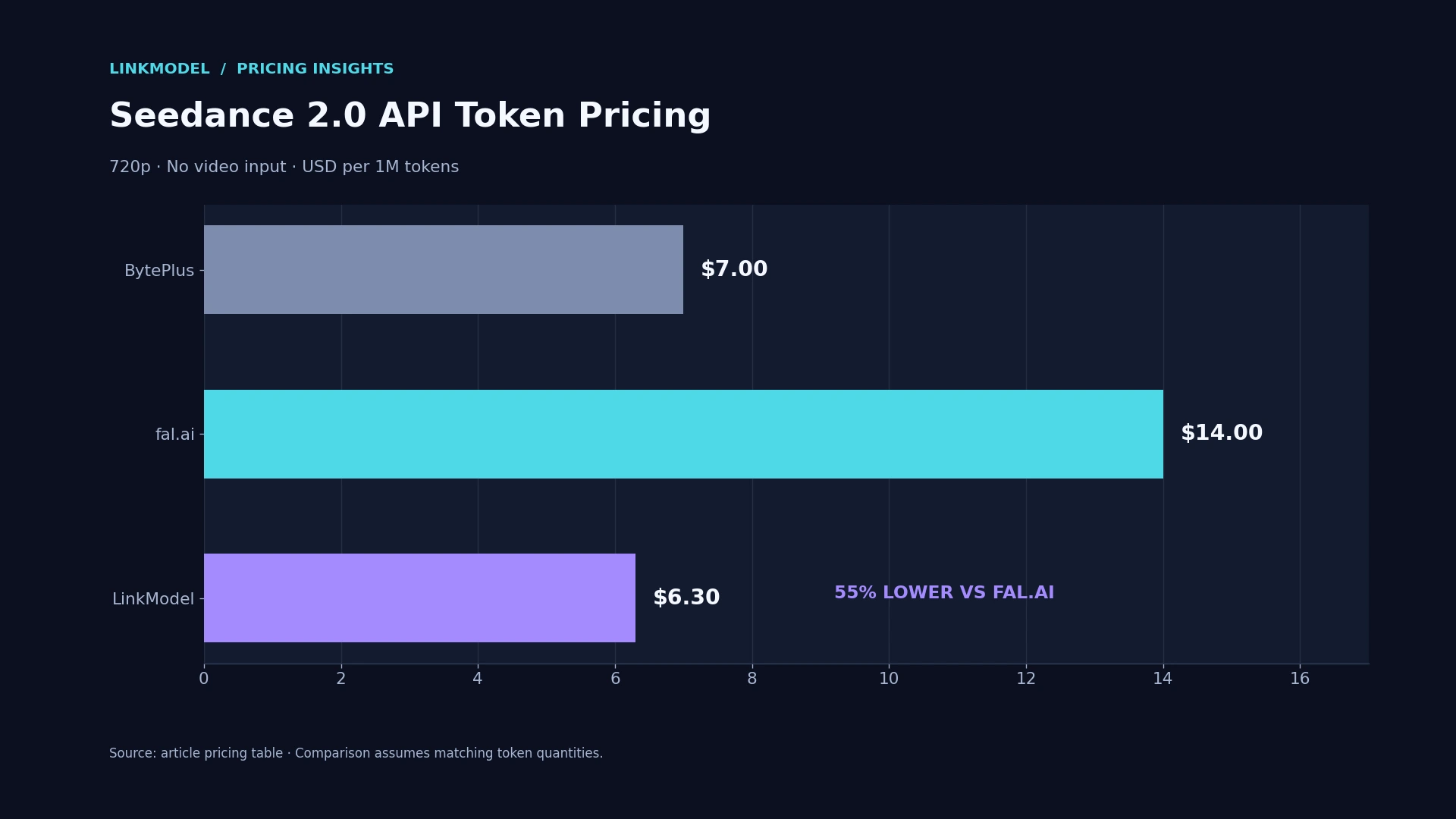
BytePlus lists the official no-video-input Seedance rates at $7.00/M for 720p and $7.70/M for 1080p. LinkModel lists $6.30/M and $6.93/M; fal lists $14.00/M.
Native million-token prices:
| Seedance workload | BytePlus official | fal native | LinkModel |
|---|---|---|---|
| 720p, no video input | $7.00/M | $14.00/M | $6.30/M |
| 1080p, no video input | $7.70/M | $14.00/M | $6.93/M |
Converted per-second estimates:
| Seedance workload | Official calculation* | fal calculation* | LinkModel calculation* |
|---|---|---|---|
| 720p, no video input | $0.15120 | $0.30240 | $0.13608 |
| 1080p, no video input | $0.37422 | $0.68040 | $0.336798 |
Sources: BytePlus pricing, fal Seedance page, and LinkModel models. Derived from the published token rates at 24 fps; these are calculations, not independent provider quotes.
Cost for 1,000 generated seconds
| Workload | BytePlus official calculation | fal native-token calculation | LinkModel calculation |
|---|---|---|---|
| 1,000 sec at 720p | $151.20 | $302.40 | $136.08 |
| 1,000 sec at 1080p | $374.22 | $680.40 | $336.798 |
The per-second view is useful for planning. It becomes a weak comparison when the token formula disappears and only the rounded second remains. LinkModel keeps the official-style million-token row visible, so the discount or markup is easier to see.
How Much Can LinkModel Save on Seedance 2.0?
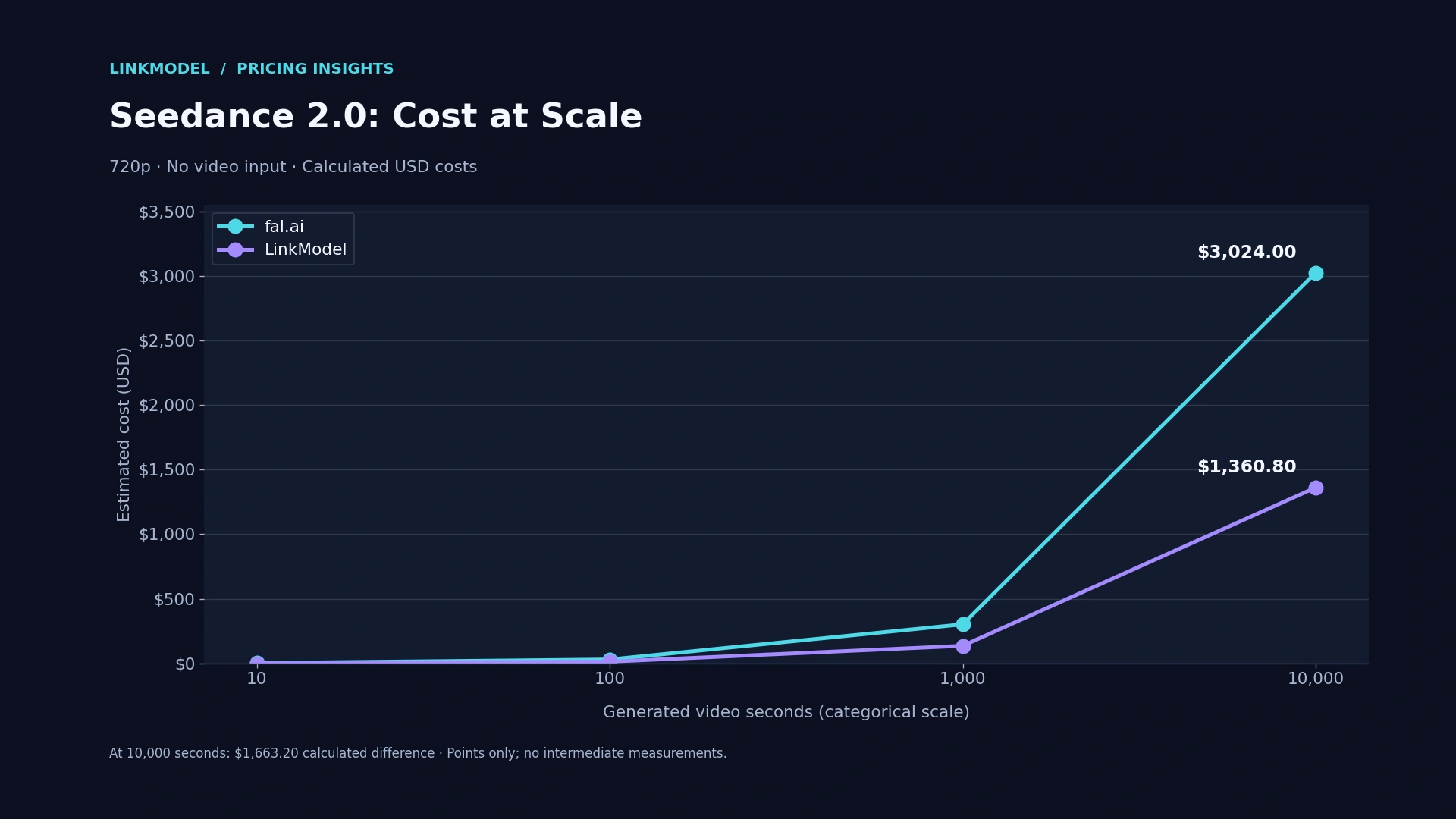
For the 720p, no-video-input scenario, LinkModel's published calculated rate is $0.13608 per generated second, compared with $0.30240 per second calculated from fal.ai's $14/M native token rate.
| Generated video | fal.ai calculated cost | LinkModel calculated cost | Difference |
|---|---|---|---|
| 10 seconds | $3.024 | $1.3608 | $1.6632 |
| 100 seconds | $30.24 | $13.608 | $16.632 |
| 1,000 seconds | $302.40 | $136.08 | $166.32 |
| 10,000 seconds | $3,024.00 | $1,360.80 | $1,663.20 |
LinkModel's token rate is 55% lower in this specific comparison. This is a calculated rate difference, not a measured reduction in production bills. The estimates assume equivalent output-token quantities, matching generation settings, and no additional billable inputs or retries.
For production use, verify the available endpoint, input modalities, output resolution, and current rate before estimating savings. See LinkModel's Seedance 2.0 API pricing.
fal.ai Models Pricing for GPT Image 2 Tokens
fal’s GPT Image 2 page publishes the upstream token categories:
| GPT Image 2 category | OpenAI official / 1M tokens | fal.ai / 1M tokens | LinkModel / 1M tokens |
|---|---|---|---|
| Text input | $5.00 | $5.00 | $3.75 |
| Cached text input | $1.25 | $1.25 | $0.9375 |
| Image input | $8.00 | $8.00 | $6.00 |
| Cached image input | $2.00 | $2.00 | $1.50 |
| Image output | $30.00 | $30.00 | $22.50 |
Sources: OpenAI API pricing, fal image model page, and the LinkModel models; verified July 22, 2026.
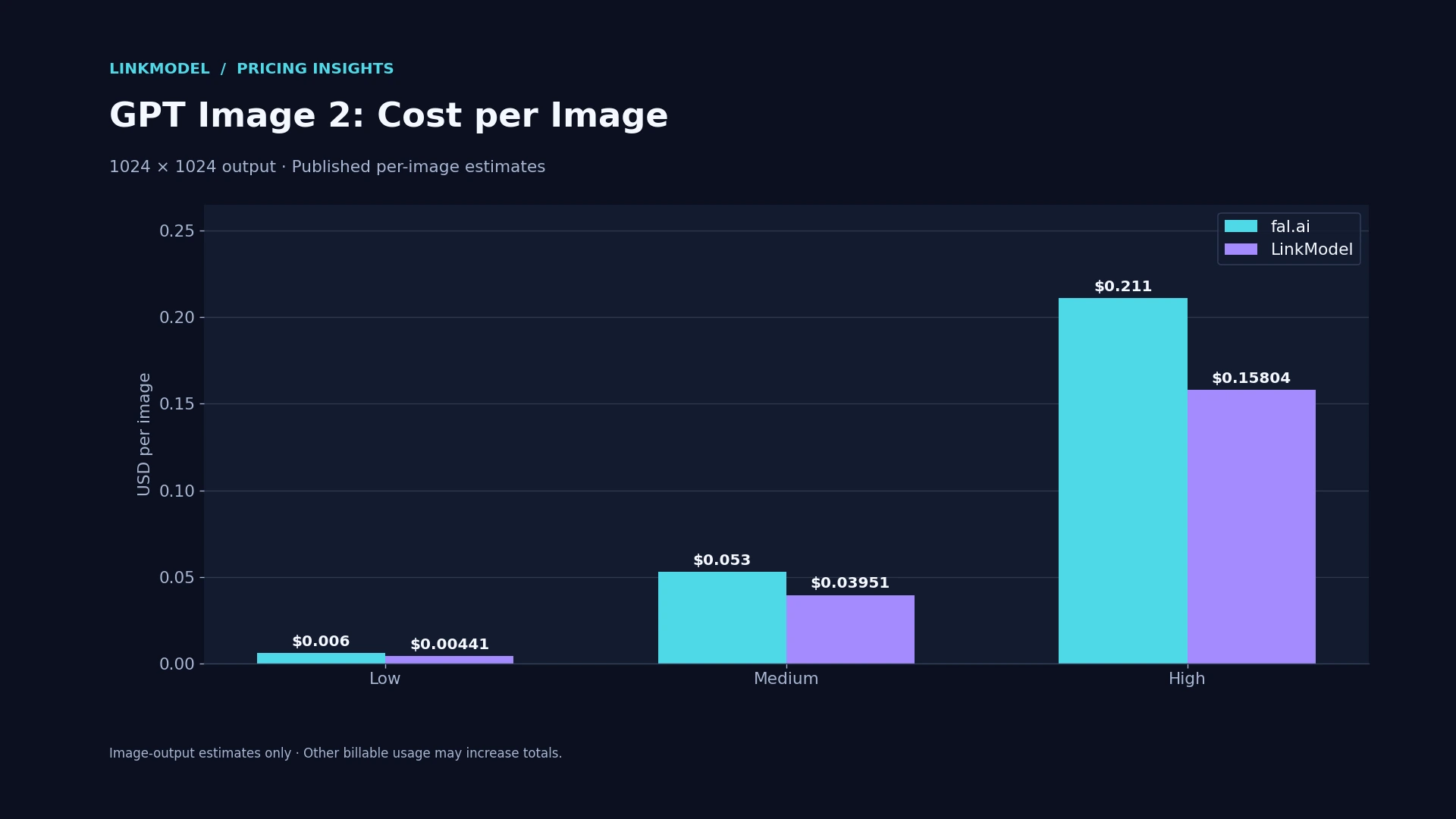
fal also publishes canonical per-image examples because quality and size change the number of image tokens. For example, its 1024×1024 table lists $0.006 low, $0.053 medium and $0.211 high.
Per-image presets are convenient. Token categories are better when your application mixes text, cached context, image input and output. LinkModel’s rate is 25% lower in every same token category listed above.
GPT Image 2: What Do the Savings Mean per Image?
Token prices help developers understand billing, but per-image costs make provider comparisons easier. For 1024×1024 output, fal.ai and LinkModel publish the following image-generation estimates:
| Image quality | fal.ai | LinkModel |
|---|---|---|
| Low | $0.006 | $0.00441 |
| Medium | $0.053 | $0.03951 |
| High | $0.211 | $0.15804 |
Sources: fal.ai GPT Image 2 and LinkModel GPT Image 2. Prices are published estimates for the specified image-output settings; input tokens and other billable usage may increase total costs.
LinkModel's published image-output estimates are approximately 25% lower than the corresponding unrounded reference rates. However, output quality can affect total spending even more than the provider discount. Choose the lowest quality setting that reliably meets your requirements, then compare cost per accepted image rather than headline prices alone.
GPT Image 2 Batch Pricing: How Much Can You Save on 1,000 or 10,000 Images?
LinkModel's lower GPT Image 2 rates become more meaningful as generation volume increases. For a team producing 10,000 high-quality 1024×1024 images, the published price estimates suggest a potential difference of $529.60 compared with fal.ai, before additional billable usage.
| Image quality | Batch size | fal.ai estimated cost | LinkModel estimated cost | Potential savings |
|---|---|---|---|---|
| Low | 1,000 | $6.00 | $4.41 | $1.59 |
| Medium | 1,000 | $53.00 | $39.51 | $13.49 |
| High | 1,000 | $211.00 | $158.04 | $52.96 |
| High | 10,000 | $2,110.00 | $1,580.40 | $529.60 |
Calculation: Batch cost = published per-image estimate × number of generated images. Potential savings = fal.ai estimated cost − LinkModel estimated cost.
These are illustrative calculations based on the published 1024×1024 image-output estimates, not measured production invoices. They assume equivalent model settings, successful generations, and no additional billable inputs, retries, or account-specific discounts.
Which provider offers better value? For this specific image-output comparison, LinkModel has the lower estimated cost. However, the cheapest provider per generated image is not necessarily the cheapest per approved image. Teams should also evaluate output quality, retry rates, latency, and API compatibility.
Compare the latest fal.ai GPT Image 2 pricing with LinkModel's GPT Image 2 model before committing to a production budget.
fal.ai Image Pricing by Number of Images
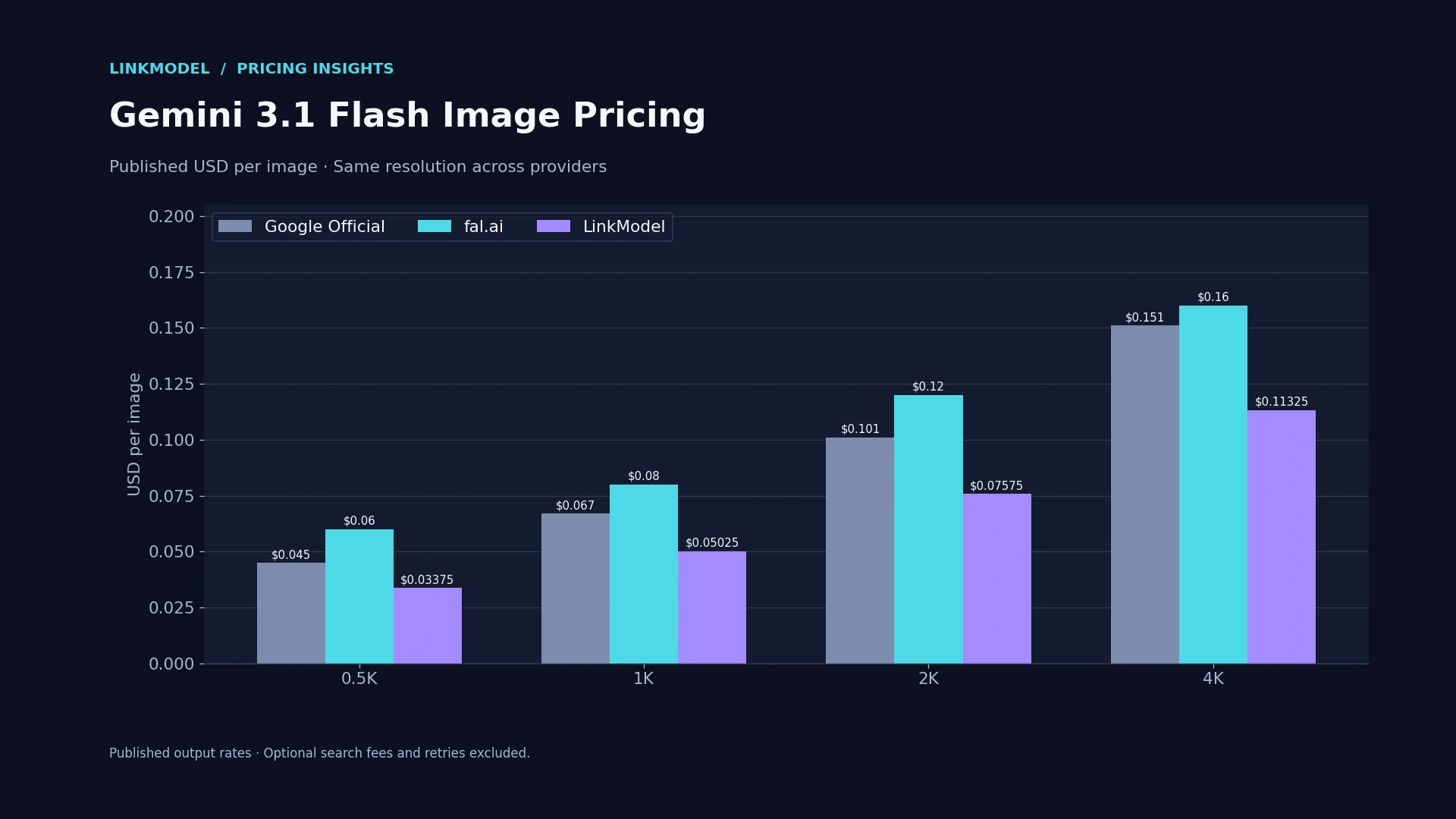
fal prices Gemini 3.1 Flash Image at $0.08 for 1K, with 0.75× for 512, 1.5× for 2K and 2× for 4K. LinkModel publishes direct call prices for 0.5K, 1K, 2K and 4K.
Per-image prices:
| Resolution | Google official / image | fal.ai / image | LinkModel / image |
|---|---|---|---|
| 0.5K | $0.04500 | $0.06000 | $0.03375 |
| 1K | $0.06700 | $0.08000 | $0.05025 |
| 2K | $0.10100 | $0.12000 | $0.07575 |
| 4K | $0.15100 | $0.16000 | $0.11325 |
Cost for 10,000 images:
| Resolution | Google official | fal.ai | LinkModel |
|---|---|---|---|
| 0.5K | $450.00 | $600.00 | $337.50 |
| 1K | $670.00 | $800.00 | $502.50 |
| 2K | $1,010.00 | $1,200.00 | $757.50 |
| 4K | $1,510.00 | $1,600.00 | $1,132.50 |
Sources: Google API pricing, fal Gemini image page, and the LinkModel models. fal adds $0.015 when web search is used; that optional feature is excluded from the table.
How Resolution Changes Gemini 3.1 Flash Image Costs
Image resolution can have a greater impact on your total API bill than a small difference in provider rates. Based on fal.ai's published image-output pricing, generating 10,000 images would cost approximately:
| Resolution | Cost per image | Cost for 10,000 images |
|---|---|---|
| 512 | $0.06 | $600 |
| 1K | $0.08 | $800 |
| 2K | $0.12 | $1,200 |
| 4K | $0.16 | $1,600 |
These estimates exclude optional features, retries, and other applicable charges. Enabling web search may introduce an additional fee of $0.015 per request, depending on the endpoint configuration.
For high-volume image generation, compare the same resolution, output settings, and cost per accepted image across providers. If you're evaluating LinkModel pricing, verify the current model-specific rate before calculating potential savings.
fal GPU Pricing: List Rate vs “As Low As”
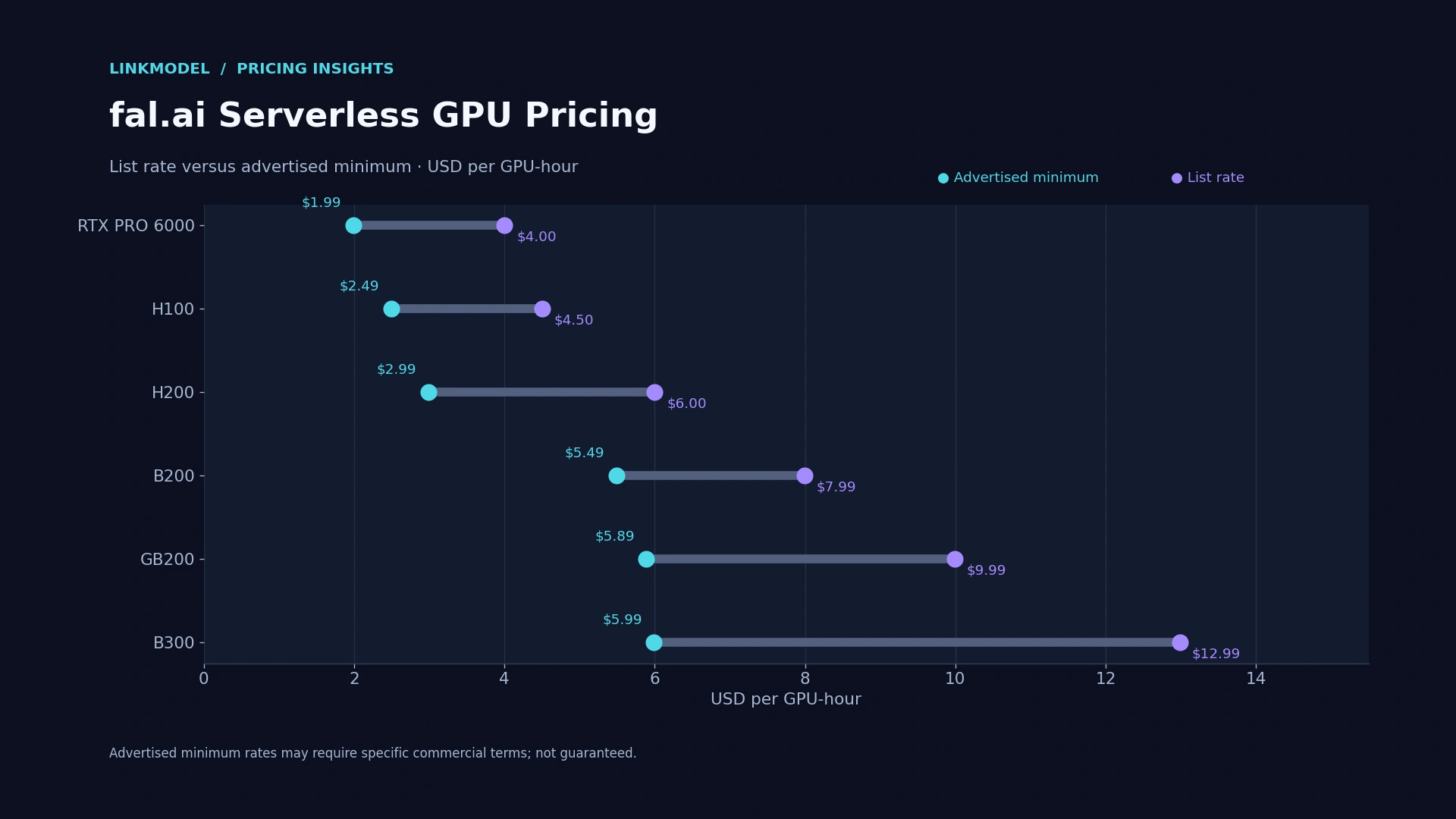
fal publishes both standard list rates and lower advertised "as low as" rates for Serverless GPU deployments.
| GPU | VRAM | List price/hour | As low as/hour |
|---|---|---|---|
| B300 | 288 GB | $12.99 | $5.99 |
| GB200 | 192 GB | $9.99 | $5.89 |
| B200 | 192 GB | $7.99 | $5.49 |
| H200 | 141 GB | $6.00 | $2.99 |
| H100 | 80 GB | $4.50 | $2.49 |
| RTX PRO 6000 | 96 GB | $4.00 | $1.99 |
Source: fal.ai official pricing. Pricing checked October 15, 2026.
"As low as" does not mean every deployment qualifies for that rate. The lower advertised prices may depend on commercial terms, usage volume, or capacity arrangements. Use the published list rate for conservative estimates unless your applicable price has been confirmed.
How fal Serverless GPU Cost Is Calculated
fal Serverless documentation describes billing over total runner lifetime. Depending on configuration, that can include:
- setup;
- idle time;
- active processing;
- draining;
- teardown.
Pending tasks and image pulls are described separately from active runner billing. Settings such as keep_alive, minimum concurrency and the number of GPUs can materially change cost.
Basic fal GPU formula
Estimated GPU compute cost = GPU hourly rate × billable runner seconds ÷ 3,600 × GPU count
For one H100 GPU with 20 minutes (1,200 seconds) of billable runner time:
- List rate: $4.50 × 1,200 ÷ 3,600 = $1.50
- Advertised minimum: $2.49 × 1,200 ÷ 3,600 = $0.83
These are calculated compute costs, not guaranteed invoice amounts. Actual charges depend on the applicable GPU rate, billable runner lifetime, utilization, deployment configuration, and number of GPUs.
For production budgeting, include setup time, idle capacity, and retry overhead wherever they contribute to billable runner time.
When fal GPU Is Cheaper—and When It Is Not
fal GPU can be more economical when:
- utilization is consistently high;
- you batch requests efficiently;
- custom code or model control removes other tooling;
- a fixed hosted output price includes a margin you can avoid;
- the lower GPU rate is actually available.
A hosted Model API can be cheaper when:
- traffic is sporadic;
- cold and idle capacity would dominate runner time;
- you value a fixed output unit;
- engineering time to package, observe and optimize the model is significant.
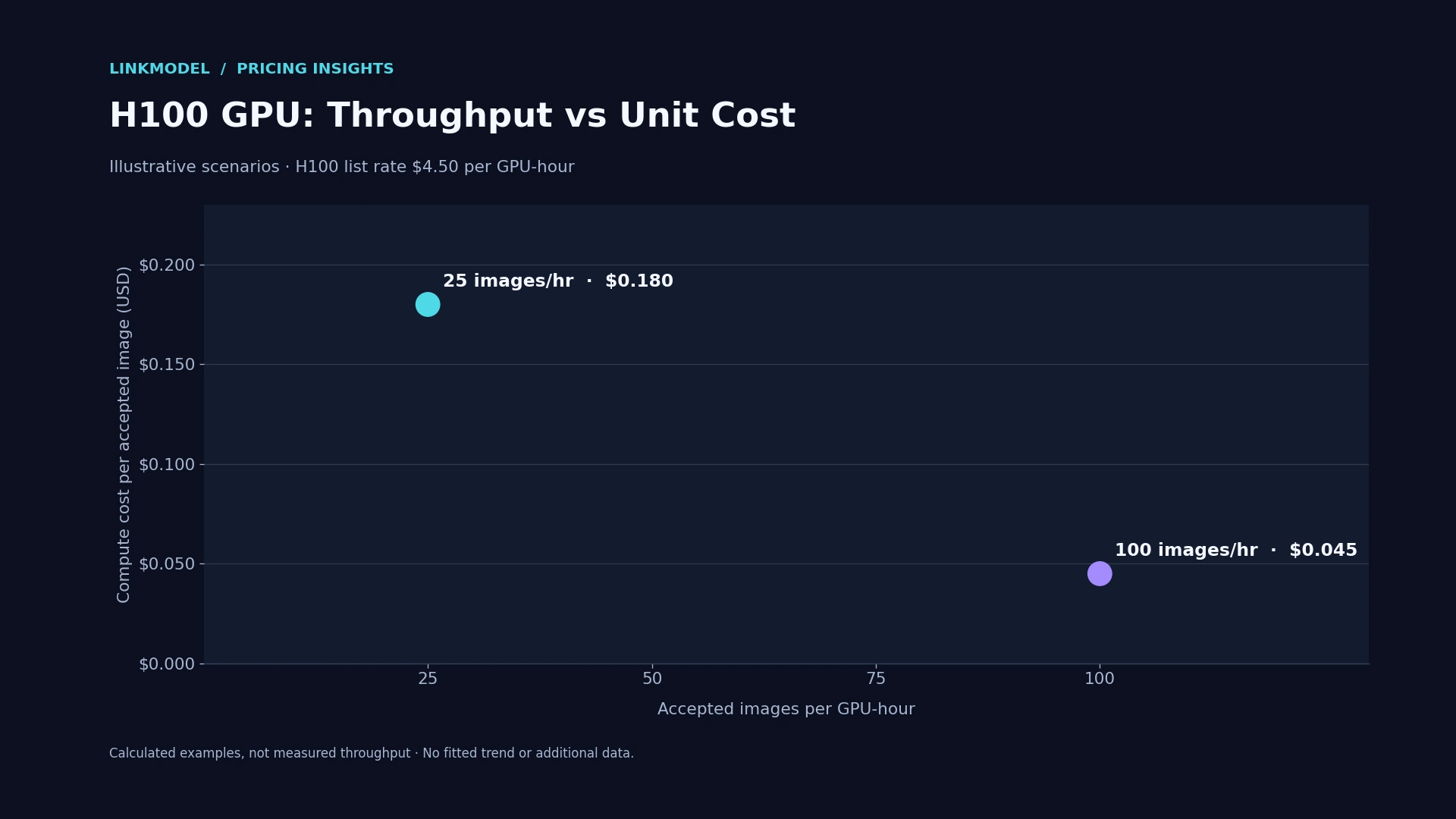
A cheaper GPU-hour does not automatically mean a cheaper generated image. At the current $4.50/hour H100 list rate, producing 100 accepted images per billable GPU-hour results in an estimated compute cost of $0.045 per accepted image. At only 25 accepted images per hour, that increases to $0.18 per image.
These are illustrative calculations, not measured throughput benchmarks. Compare the results with hosted API pricing for the same model, resolution, quality, and acceptance criteria. Serverless GPUs can be economical for highly utilized custom deployments, while hosted APIs often simplify budgeting for variable or intermittent demand.
fal.ai vs LinkModel vs Official APIs: Which Provider Offers Better Value?
LinkModel is worth considering when your priority is lower API costs for supported commercial models. fal.ai is better suited to teams that also need managed inference and custom GPU deployments, while official APIs offer direct access to model providers and their native features. The best choice depends on your workload, pricing structure, and infrastructure requirements.
| Comparison | fal.ai | LinkModel | Official model APIs |
|---|---|---|---|
| Primary offering | Hosted model inference and Serverless GPUs | Unified API access to multiple AI models | Direct access to a model developer |
| Pricing structure | Per image, video second, token, or GPU time depending on endpoint | Model-specific API rates | Provider-specific token, image, or video rates |
| GPT Image 2 output pricing | Published image-quality estimates | Lower published estimates for comparable output settings | Official token-based pricing |
| Custom GPU deployment | Supported through Serverless | Not a primary advertised offering | Depends on the provider |
| Multiple model families | Available through hosted endpoints | Available through a unified API | Often requires separate provider integrations |
| Main advantage | Model hosting and infrastructure flexibility | Competitive pricing and simpler multi-model access | Direct access to official features and documentation |
| Best suited for | Teams needing hosted inference or custom deployments | Developers optimizing supported model API costs | Teams prioritizing direct vendor relationships and native capabilities |
When Should You Choose fal.ai?
Choose fal.ai when you need access to hosted image and video endpoints alongside configurable GPU infrastructure. Its Serverless offering is particularly relevant for custom inference pipelines, model deployments, and workloads where you can control GPU utilization.
However, GPU-hour pricing should not be compared directly with per-image API pricing. Calculate the cost per accepted output, including billable runner time and utilization.
When Does LinkModel Make More Financial Sense?
LinkModel is a strong option when the same commercial model is available at a lower published rate and you do not need to manage custom GPU infrastructure. For example, the GPT Image 2 batch calculation above suggests $529.60 in potential savings on 10,000 high-quality 1024×1024 images, based on the compared image-output estimates.
LinkModel also offers a unified API for supported image, video, and language models, which can reduce the integration work involved in using multiple model providers.
Before migrating, verify that your required model version, generation settings, API behavior, and billing units are supported. Compare the current rates on the LinkModel pricing page.
When Are Official APIs the Better Choice?
Direct APIs may be preferable when you require newly released provider-specific features, official SDK behavior, a direct vendor support relationship, or contractual arrangements that are not available through a third-party gateway.
Official pricing is not necessarily the lowest effective price for every workload. Compare token categories, available batch discounts, caching, and the total cost of maintaining separate provider integrations.
Final Recommendation
For custom inference infrastructure, start with fal.ai. For cost-sensitive access to supported commercial models, compare LinkModel first. For direct vendor features and relationships, evaluate the official API.
If your application primarily generates images or videos, begin with a small, matched test across available providers. Measure the actual cost per accepted output, output quality, latency, and retry rate before committing to high-volume production.
For a broader provider comparison, see our fal.ai alternatives guide.
fal Credits, Concurrency and Failed Requests
- Purchased credits expire after 365 days.
- New Model API accounts start with 2 concurrent requests.
- Limits can rise with paid invoices over the last four weeks, self-service up to 40.
- Requests above the limit queue.
- Server errors and queue time are not charged.
- Some 422 requests can be charged if GPU work occurred before validation.
These rules belong in your cost model because throughput and error handling affect how quickly credits are consumed.
How to Avoid Unexpected fal.ai API Costs
Before scaling an application, check your account balance, applicable billing rules, request limits, and expected retry rate. Do not assume that every failed request is free or that prepaid credits automatically prevent all additional charges.
For example, if your application requires 1,000 accepted images but averages 1.25 billable attempts per accepted result, your budget should account for approximately 1,250 billable generations.
Track usage by endpoint, distinguish failed attempts from billable attempts, and monitor cost per accepted output. This is especially important for automated image and video workflows where small differences in retry rates can compound at scale.
Frequently Asked Questions
Is fal.ai priced per second?
Some video Model APIs are priced per generated second, but not every fal product uses that unit. Seedance also publishes a native token price, and Serverless uses GPU runner lifetime.
Does fal.ai price every model by GPU time?
No. Hosted Model APIs usually use an output unit. GPU time is central to the separate Serverless product and some endpoints without predefined output pricing.
What does fal GPU “as low as” mean?
It is the lowest displayed rate, not necessarily the rate for every account or job. Budget with list price until eligibility is confirmed.
Is fal.ai cheaper than LinkModel?
It varies by model. In the verified Seedance, GPT Image 2 token-category and Gemini 3.1 Flash Image comparisons above, LinkModel is lower. The fal.ai alternatives guide compares other providers for teams considering a switch.
How do I estimate 10,000 fal image generations?
Multiply the exact per-image rate by 10,000, then add optional features such as web search and account-specific discounts. Do not use a 1K price for 4K output.
Can fal charge a failed request?
fal says 500-series errors are not charged. A 422 client error may be billable when GPU work occurred before the error was detected.
conclusion
fal.ai pricing is best evaluated by total cost per accepted output, not by the lowest advertised API or GPU rate. Hosted Model APIs simplify access to ready-to-use models, while Serverless GPUs provide more deployment control when utilization justifies compute-based billing. Current GPU list rates range from $4.00 to $12.99 per hour, and actual model costs vary with resolution, duration, tokens, and retries. For supported commercial image and video models, LinkModel offers a compelling price alternative through its unified API, including a calculated 55% lower Seedance 2.0 token rate in the 720p scenario examined above. Compare matching configurations and real workload costs before choosing a provider. For a broader feature and deployment comparison, read our LinkModel vs fal.ai guide.