Atlas Cloud is the better fit for broad hosted AI model access, while fal.ai is stronger for creative-model tooling, asynchronous inference, and custom Serverless GPU deployments. Atlas Cloud helps teams consolidate access to language, image, and video models. fal.ai offers a more specialized environment for media-generation workflows and custom inference infrastructure. Neither is universally cheaper: pricing depends on the model, endpoint, configuration, and billing unit.
The biggest mistake in comparing Atlas Cloud vs fal.ai is treating every API as an equivalent product. A low-cost Mini video model cannot be compared directly with a Standard endpoint, and GPU-hour pricing does not represent the cost of a managed video API. Production decisions also depend on queue latency, retries, output quality, and the cost of each usable result.
For developers who want competitively priced managed inference without deploying custom GPUs, LinkModel is a useful third option. Its Seedance 2.0 720p no-video-input calculation lists $0.13608 per generated second, compared with fal.ai's displayed $0.3034 per second for its 720p Standard text-to-video endpoint. The published figures differ by approximately 55.1%, making LinkModel worth evaluating when the endpoint capabilities and billing conditions meet your needs.
Atlas Cloud vs fal.ai: Which Is Better?
Choose Atlas Cloud if your priority is accessing multiple hosted AI models through one account. Choose fal.ai if your application needs specialized generative-media APIs, robust asynchronous workflows, or custom inference infrastructure.
| Decision factor | Atlas Cloud | fal.ai | Better fit |
|---|---|---|---|
| Core offering | Hosted model marketplace | Model APIs and Serverless compute | Depends on the workload |
| Model discovery | Broad hosted model catalog | Creative-model ecosystem | Atlas Cloud for general breadth |
| Creative workflows | Model-specific task support | Specialized media APIs and workflows | fal.ai |
| Custom code and GPUs | Not the primary hosted API focus | Custom Serverless deployments | fal.ai |
| API integration | Centralized account and billing | Model-specific SDKs and queue clients | Depends on architecture |
| Billing | Model-specific tokens, outputs, or duration | Endpoint billing or compute time | Compare exact endpoints |
| Concurrency | Model- and account-dependent | Documented global and endpoint limits | Verify capacity |
| Best buyer | Team consolidating hosted models | Creative AI or infrastructure team | Workload-dependent |
The most important distinction is the type of product your application needs.
A team building a multi-model content platform may value Atlas Cloud's centralized access. A team building a video-generation service with background jobs, specialized creative inputs, and custom inference code may find fal.ai more suitable.
These strengths overlap, but they are not interchangeable.
How Do Atlas Cloud and fal.ai API Platforms Differ?
Both providers offer hosted inference, but their infrastructure and developer workflows emphasize different needs.
Atlas Cloud: Broad Hosted AI Model Access
Atlas Cloud provides access to multiple model families through one provider account.
Its catalog includes language, image, video, and other supported AI models. This is useful for teams that want to evaluate several providers or combine different AI capabilities in one application.
Consider an e-commerce content platform that generates product descriptions, promotional images, and short videos.
Using a centralized provider can simplify procurement and account management. It may also reduce the number of separate billing relationships a development team must maintain.
However, a unified account does not guarantee a unified request schema or identical operating limits across every model.
Different endpoints may use different input parameters, output formats, task lifecycles, and billing rules.
Atlas Cloud also supports OpenAI-compatible patterns for certain language-model workflows, but that does not mean every creative endpoint follows the same interface.
For a broader platform assessment, see the Atlas Cloud review and Atlas Cloud alternatives guide.
fal.ai: Creative Model APIs and Asynchronous Workflows
fal.ai offers managed Model APIs for supported image, video, audio, and other generative tasks.
Its creative-model ecosystem includes specialized endpoints, playgrounds, SDK integrations, and asynchronous execution patterns.
A typical video-generation application may submit a request, receive a request identifier, track its progress, and retrieve the output when processing finishes.
This architecture is valuable because video generation often takes longer than an interactive application can comfortably wait.
For example, a creative platform can accept several customer requests, place them in a background workflow, and display results as they become available.
fal.ai's advantage is not just model availability. It is the tooling around long-running creative inference.
The platform also offers workflow composition for applications that need to connect multiple model operations.
fal.ai Serverless: When Custom GPU Infrastructure Matters
fal.ai Serverless is separate from its managed Model APIs.
It supports deploying custom inference applications with greater control over code and computing resources.
This matters when a team needs a custom runtime, specialized dependencies, or inference behavior that a fixed hosted endpoint cannot provide.
However, Serverless compute pricing and managed Model API pricing should be evaluated separately.
A GPU-hour rate measures billable compute time. A hosted video API may instead charge by generated seconds or model tokens.
A custom deployment may offer flexibility, but its effective cost depends on utilization, execution time, and operational overhead.
For applications that only need a supported hosted model, a managed API can be simpler to operate.
Atlas Cloud vs fal.ai Pricing: Which Is Cheaper?
Neither provider has a universal pricing advantage. The answer changes by model family, endpoint, resolution, input type, and billing unit.
Atlas Cloud offers model-specific prices across its hosted catalog. fal.ai uses endpoint-specific pricing for managed Model APIs and separate compute-based pricing for Serverless.
A fair comparison should begin with the exact model and task, not a provider-wide headline rate.
Atlas Cloud vs fal.ai Pricing Models
| Pricing question | Atlas Cloud | fal.ai |
|---|---|---|
| Is pricing uniform across models? | No | No |
| Can hosted models bill by output? | Yes, depending on model | Yes, depending on endpoint |
| Can video cost depend on duration? | Yes | Yes |
| Are token-based calculations relevant? | For supported models | For supported endpoints |
| Is custom GPU compute a separate offering? | Not the core hosted API proposition | Yes, through Serverless |
| Are promotional or tier-specific rates possible? | Yes | Model and account terms may vary |
| Best comparison method | Exact model and configuration | Exact endpoint and configuration |
The correct pricing question is not “Which website is cheaper?” but “Which provider offers the required model and configuration at the lowest effective production cost?”
Seedance 2.0 Pricing: A Model-Level Example
Seedance 2.0 illustrates why model variants must be distinguished.
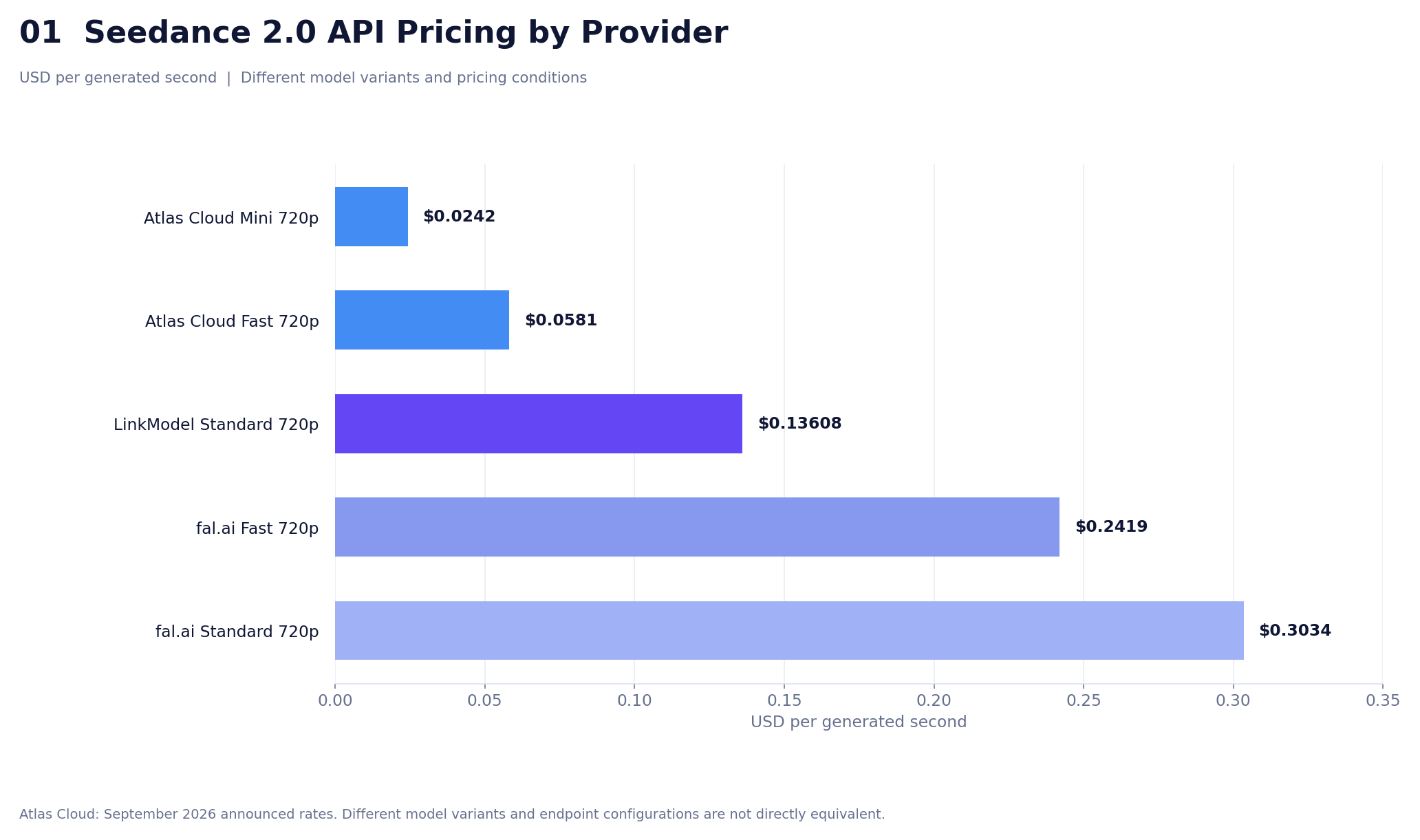
Atlas Cloud has published prices for Mini and Fast variants. LinkModel and fal.ai also list model-specific rates.
| Provider | Model | Configuration | Published or announced rate |
|---|---|---|---|
| Atlas Cloud | Seedance 2.0 Mini | 720p, announced September rate | $0.0242/sec |
| Atlas Cloud | Seedance 2.0 Fast | 720p, announced September rate | $0.0581/sec |
| LinkModel | Seedance 2.0 Standard | 720p, no video input | $0.13608/sec |
| fal.ai | Seedance 2.0 Fast | 720p | $0.2419/sec |
| fal.ai | Seedance 2.0 Standard | 720p | $0.3034/sec |
Atlas Cloud's Mini and Fast prices are drawn from its September 2026 price announcement, rather than a verified live checkout quote. They should be revalidated before making a purchase.
The table also compares different model variants and endpoint configurations. It is useful for identifying candidate options, not for declaring that one provider is universally cheaper under identical conditions.
For developers who need the standard Seedance 2.0 model, LinkModel's listed rate is below fal.ai's displayed Standard rate.
For developers who can use a lighter variant, Atlas Cloud's announced Mini and Fast rates may be attractive.
How LinkModel's Standard Rate Compares with fal.ai
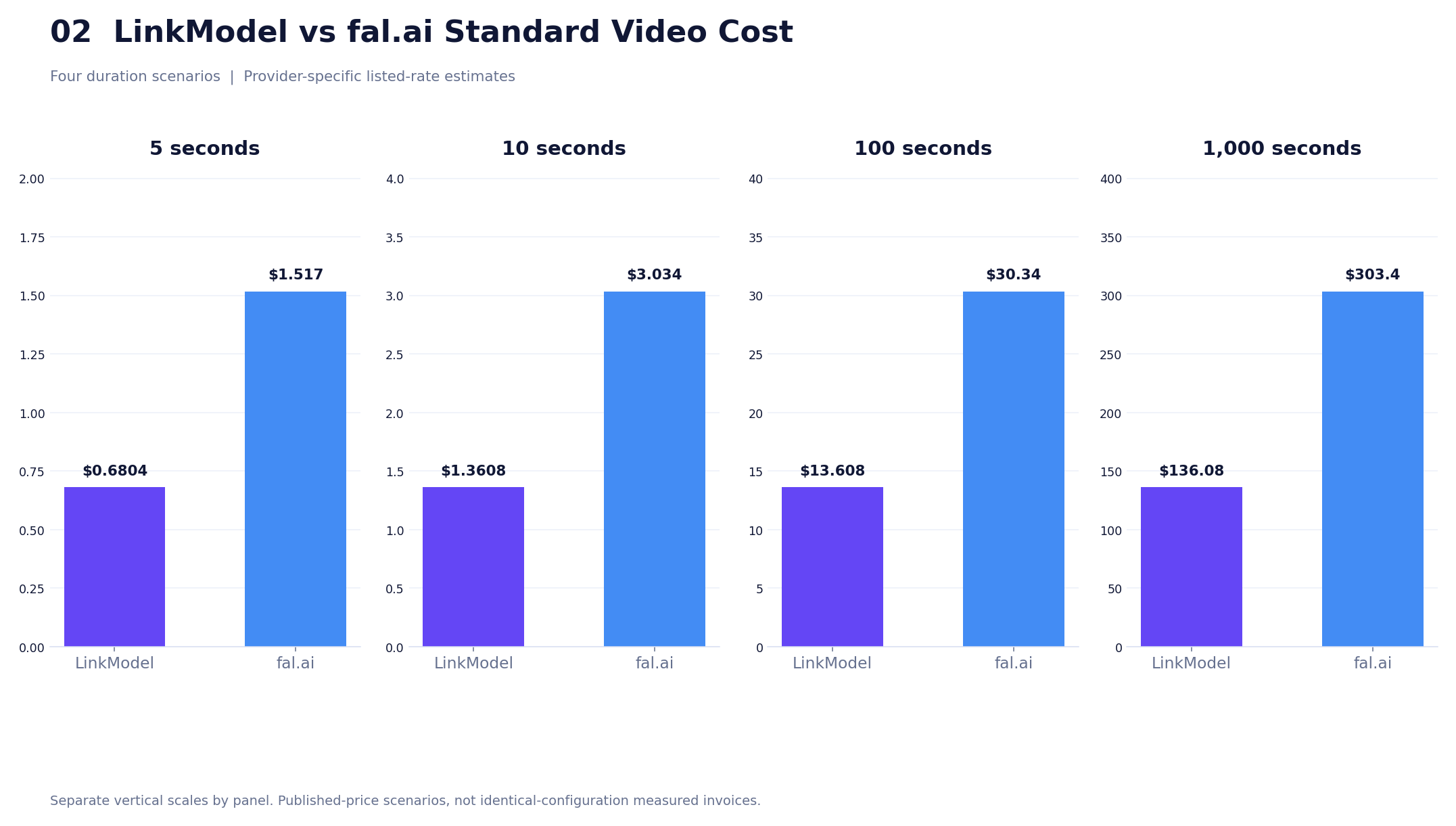
LinkModel's Seedance 2.0 model page publishes a 720p no-video-input estimate of $0.13608 per generated second.
fal.ai's Standard text-to-video endpoint displays $0.3034 per second at 720p.
For the referenced prices:
| Generated duration | LinkModel | fal.ai Standard |
|---|---|---|
| 5 seconds | $0.6804 | $1.5170 |
| 10 seconds | $1.3608 | $3.0340 |
| 100 seconds | $13.6080 | $30.3400 |
| 1,000 seconds | $136.08 | $303.40 |
The arithmetic difference is approximately 55.1%.
However, these displayed prices are associated with provider-specific conditions. fal.ai's endpoint supports native audio, while LinkModel's calculation is based on its specified no-video-input pricing formula.
The price difference is a useful reason to evaluate LinkModel, not proof that every identical production request will cost exactly 55.1% less.
What Does Atlas Cloud vs fal.ai Cost at Production Scale?
Published API rates become more useful when translated into realistic workloads.
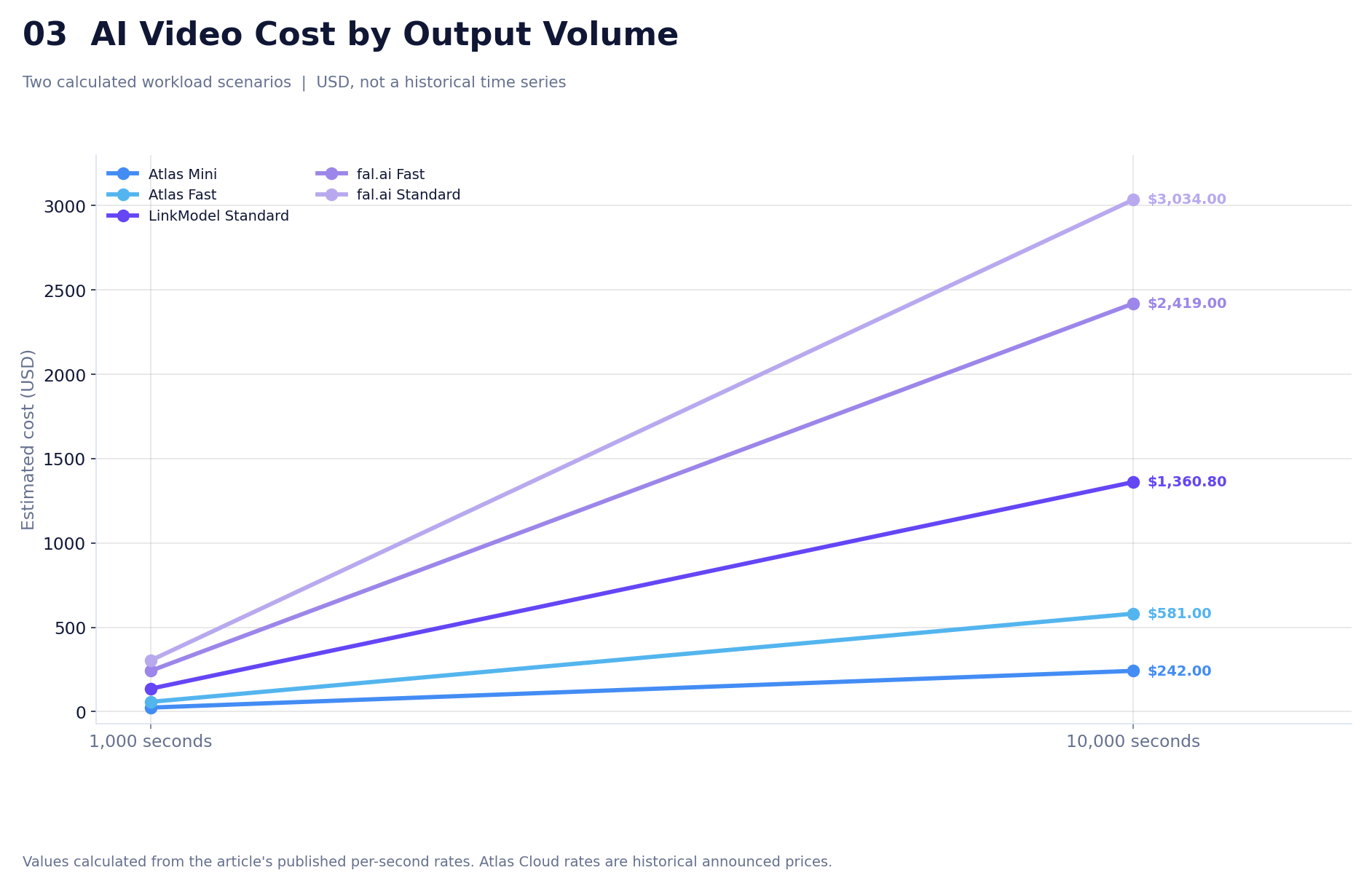
The following scenarios use the listed prices and stated assumptions. They are budget calculations rather than measured generation experiments.
Case Study: 100 Ten-Second Marketing Videos
Suppose a team needs 100 marketing videos, each 10 seconds long.
That represents 1,000 generated seconds.
This example reveals two different purchasing strategies.
If the team is producing inexpensive drafts and a lighter model meets its requirements, Atlas Cloud Mini or Fast may be attractive.
If the team requires the standard model, LinkModel's published estimate is lower than the referenced fal.ai Standard price.
The first decision is which model variant meets the quality requirement. The second is which provider offers that capability at the best effective price.
Case Study: 10,000 Seconds of Monthly Video Output
For a higher-volume application generating 10,000 seconds per month, the same rates produce these estimates:
At these listed rates, LinkModel's Standard estimate is $1,673.20 lower per month than fal.ai's displayed Standard estimate.
Over 12 months at unchanged rates and usage, that difference would equal $20,078.40.
The comparison does not account for different endpoint capabilities, additional billable inputs, retries, or quality acceptance rates.
Those factors can materially change the final production bill.
Why Cost per Accepted Output Is More Useful
A cheaper API request does not necessarily produce a cheaper usable result.
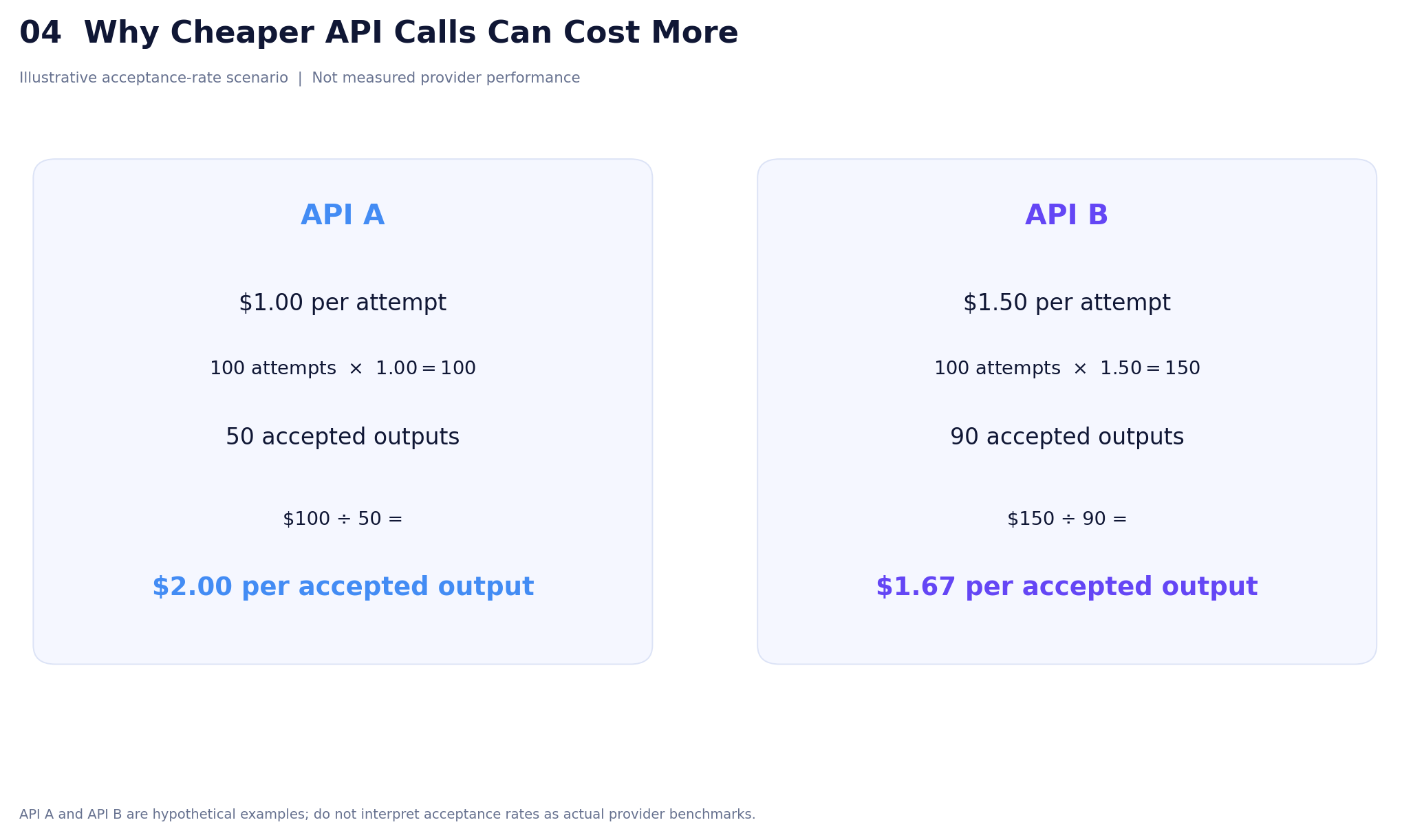
Consider a hypothetical comparison:
| Metric | API A | API B |
|---|---|---|
| Cost per attempt | $1.00 | $1.50 |
| Attempts | 100 | 100 |
| Accepted outputs | 50 | 90 |
| Total cost | $100 | $150 |
| Cost per accepted output | $2.00 | $1.67 |
API A has the lower request price.
API B has the lower cost per accepted output because more results meet the acceptance criteria.
These acceptance rates are illustrative assumptions, not measured results for Atlas Cloud, fal.ai, or LinkModel.
Cost per accepted output = Total billable generation cost ÷ Accepted outputs.
For production video workloads, this is often a better decision metric than advertised price per second.
Atlas Cloud vs fal.ai: API Features and Developer Experience
Atlas Cloud is oriented toward broad model access and account consolidation. fal.ai offers deeper tooling for specialized creative inference and custom execution.
Both approaches can reduce development work, but they simplify different parts of an application.
Atlas Cloud Integration and Model Compatibility
Atlas Cloud can simplify access to multiple hosted models through one account.
For language-model workflows, its supported OpenAI-compatible integration patterns may reduce migration work.
However, creative-model endpoints still require model-specific validation.
A practical integration review should examine authentication, request schemas, model identifiers, output formats, and error handling.
For example, an application that combines text generation with image-to-video must manage very different output lifecycles.
Unified billing does not eliminate the need for endpoint-specific application logic.
fal.ai Creative Features and Workflow Support
fal.ai offers specialized media-generation endpoints and workflow tooling.
Its Seedance 2.0 offering supports text-to-video, image-to-video, and reference-based generation workflows.
The documented Seedance 2.0 model family can accept multiple image, video, and audio references, enabling applications to guide appearance, motion, and sound.
A product-video application might use reference images to preserve product identity and a reference clip to guide camera movement.
These capabilities matter when the application requires more than a simple text prompt.
fal.ai also provides asynchronous queue tooling and workflow composition for applications that connect multiple inference operations.
For specialized creative applications, endpoint functionality and workflow support can outweigh differences in headline price.
Integration Complexity: What Developers Should Evaluate
A fair developer-experience comparison should measure more than the number of API calls needed for a basic demonstration.
Important considerations include:
- Authentication and credential management.
- Request validation and model-specific schemas.
- Asynchronous task handling.
- Error responses and retries.
- Webhooks or polling.
- Result storage.
- Monitoring and usage reporting.
- Migration effort when switching models.
Atlas Cloud may reduce account and procurement complexity.
fal.ai may simplify specialized creative execution.
The better choice depends on which complexity matters most to the application.
Atlas Cloud vs fal.ai: Concurrency, Queues and Reliability
fal.ai documents its concurrency and queue system in detail, while Atlas Cloud's limits vary by model and account.
Neither platform should be declared universally faster without controlled endpoint testing.
fal.ai Concurrency Limits and Queue Behavior
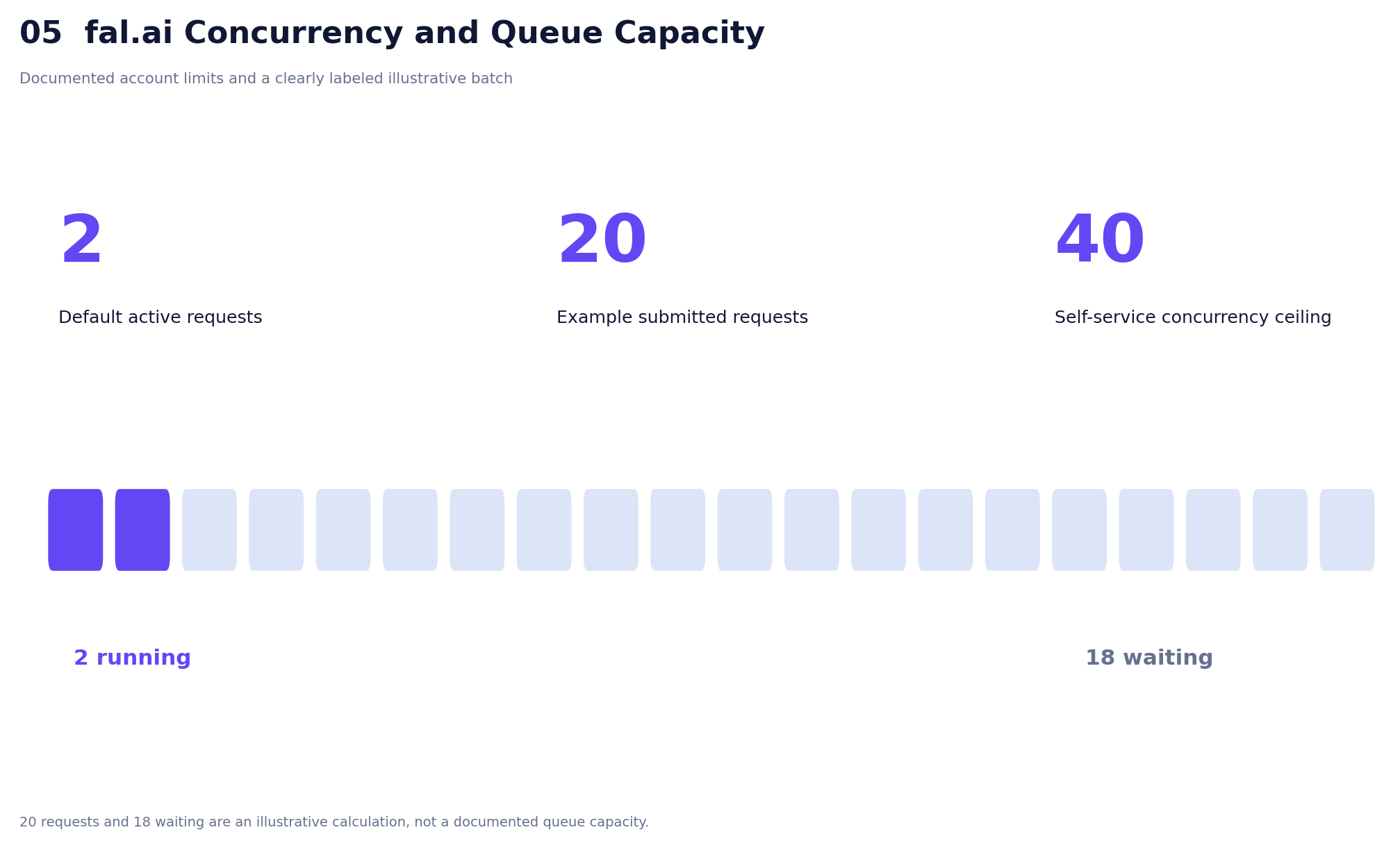
fal.ai's Model API documentation states that new accounts begin with a global concurrency limit of two in-progress requests.
The self-service limit can increase with paid credit purchases, up to 40 concurrent requests under the documented system.
Requests waiting in the queue do not count toward active concurrency.
For example, if an application submits 20 video requests with a concurrency limit of two, only two may be actively processed at once while the others wait for available capacity.
This helps applications absorb bursts, but queue waiting can still increase user-visible latency.
fal.ai also distinguishes direct requests from queue-based requests.
Its client handles concurrency-related retries for direct calls, while queue-based submissions can wait and be dispatched as capacity becomes available.
For production workloads, queue behavior is a reliability feature—not a guarantee of faster generation.
The platform documents additional per-endpoint limits for certain high-demand models, so developers should verify both account-level and endpoint-level capacity.
Atlas Cloud Concurrency and Rate Limits
Atlas Cloud documents model- and account-specific operational limits.
Developers should confirm the accepted concurrency and rate limits of the exact endpoint they plan to use.
A model marketplace can offer broad access without guaranteeing identical throughput across every model.
For a small application, modest concurrency may be sufficient.
For a high-volume video service, burst handling, queue waiting, and capacity escalation become important purchasing criteria.
How to Compare Real API Performance
A useful benchmark should record:
| Metric | Why it matters |
|---|---|
| p50 latency | Typical completion time |
| p95 latency | Slow-request experience |
| Queue wait time | Delay before execution |
| Execution time | Model-processing duration |
| Success rate | Reliability |
| HTTP 429 frequency | Rate-limit behavior |
| Retry count | Additional workload |
| Accepted-output rate | Usable generation efficiency |
For asynchronous APIs, end-to-end latency includes queue waiting, execution, and result retrieval.
A provider may perform well under light traffic but behave differently during a burst.
The correct benchmark uses the same model, workload, and concurrency conditions wherever the endpoints support them.
Atlas Cloud vs fal.ai: Credits, Refunds and Data Retention
Commercial and data-handling policies can affect the real cost and operational risk of an API provider.
These considerations are particularly important for applications processing customer media or operating with prepaid balances.
Credit Expiration and Refunds
Atlas Cloud documents a $25 minimum top-up, 365-day expiration for purchased credits, and non-refundable top-ups under its published terms.
fal.ai also documents expiration and refund conditions for purchased credits, including a 365-day expiration period.
However, account-specific funding requirements may differ.
For occasional API usage, unused prepaid credits can become an indirect cost.
For continuous production usage, spending controls and billing visibility may matter more.
A lower model price is less useful if commercial terms make the actual workload more expensive to operate.
Atlas Cloud Data Retention Controls
Atlas Cloud distinguishes generated media from request records.
Generated media includes hosted image, video, and audio files.
Request records can include prompts, parameters, status information, and output URLs.
Its documentation allows developers to configure separate retention periods for these categories.
Generated media retention can be set from 1 to 336 hours, while request-record retention can be set from 0 to 336 hours.
The maximum of 336 hours equals 14 days.
This separation matters because deleting a request record does not necessarily delete its generated media, and deleting media does not automatically remove the request record.
Developers can review these controls in Atlas Cloud's data retention documentation.
fal.ai Data Retention and Media Access
fal.ai documents a default retention period of 30 days for JSON inputs and outputs.
Generated media follows a separate CDN lifecycle, and access-control configuration affects how files can be retrieved.
This is not directly equivalent to Atlas Cloud's retention settings because the policies describe different categories of stored information.
Applications handling private customer media should examine:
- Prompt and input retention.
- Generated-file expiration.
- Public or private output URLs.
- Available deletion controls.
- Downstream processing.
- Long-term storage requirements.
For production applications, copy important outputs into storage you control and apply the appropriate access restrictions.
The relevant policies are described in fal.ai's data retention documentation.
Which Should You Choose: Atlas Cloud, fal.ai or LinkModel?
Choose Atlas Cloud for broad hosted-model access, fal.ai for creative workflows and custom inference, and LinkModel for competitive managed API pricing where its supported endpoints meet your needs.
| Your priority | Best starting point | Main reason |
|---|---|---|
| Explore multiple hosted models | Atlas Cloud | Broad model access |
| Consolidate provider accounts | Atlas Cloud | Centralized billing and discovery |
| Build creative media workflows | fal.ai | Specialized APIs and queues |
| Deploy custom inference code | fal.ai Serverless | Runtime flexibility |
| Compare lower-cost managed APIs | LinkModel | Competitive model-specific rates |
| Generate low-cost video drafts | Evaluate Atlas Mini/Fast | Lower announced variant prices |
| Meet strict latency requirements | Benchmark exact endpoints | Queue and execution behavior vary |
| Process sensitive customer media | Review each provider's policies | Retention and access controls differ |
Choose Atlas Cloud for Model Discovery and Consolidation
Atlas Cloud is a strong candidate when an application needs multiple hosted AI models through one provider account.
Its value lies in model breadth, centralized access, and reduced provider-management overhead.
The trade-off is that developers must still understand model-specific schemas, prices, and capacity limits.
Choose fal.ai for Creative Infrastructure
fal.ai is particularly relevant for applications requiring specialized media-generation tools, asynchronous queues, or custom inference deployments.
Its Model APIs and Serverless products provide different levels of infrastructure control.
The trade-off is additional complexity when an application uses multiple execution and billing models.
Choose LinkModel for Competitive Managed API Pricing
LinkModel is worth evaluating when your application needs supported image, video, or language models at competitive rates without custom GPU infrastructure.
Its Seedance 2.0 Standard model page lists these generation estimates:
| Resolution | LinkModel price |
|---|---|
| 480p | $0.060527/sec |
| 720p | $0.13608/sec |
| 1080p | $0.336798/sec |
The estimates use the model page's published pricing assumptions.
At 720p, LinkModel's listed Standard rate is approximately 55.1% below fal.ai's displayed $0.3034-per-second rate for the referenced configurations.
At 1080p, LinkModel lists $0.336798 per second, while fal.ai displays $0.682 per second for its Standard endpoint.
These differences make LinkModel a practical candidate for cost-sensitive managed inference, provided the required model capabilities and billing conditions align.
Its strongest advantage in this comparison is not custom GPU control. It is the ability to access supported models through a managed API platform with competitive published pricing.
Frequently Asked Questions
Is Atlas Cloud Cheaper Than fal.ai?
It depends on the model and configuration. Atlas Cloud has announced low rates for Seedance 2.0 Mini and Fast, including $0.0242 per second and $0.0581 per second at 720p. These are different variants from fal.ai's Standard endpoint, so they do not establish a same-model price advantage. Compare exact model variants, resolution, input types, and billing conditions.
Does fal.ai Charge by GPU or API Usage?
Both, depending on the product. fal.ai Model APIs use endpoint-specific billing, while Serverless uses compute-based billing for custom applications. A managed video API price should not be compared directly with a GPU-hour rate without calculating the total execution cost.
Which Is Better for High-Volume Video Generation?
The best option depends on required quality, model variant, and cost per accepted output. Atlas Cloud Mini and Fast may suit lower-cost drafts. fal.ai offers specialized creative workflows and queue tooling. LinkModel offers competitive Standard-model pricing for supported workloads. Benchmark the exact endpoints before scaling.
Is LinkModel a Good Alternative to Atlas Cloud and fal.ai?
Yes, when competitive managed API pricing is the priority. LinkModel provides supported image, video, and language models, including Seedance 2.0 at a listed $0.13608 per second for its specified 720p configuration. It is especially relevant when an application needs hosted inference rather than custom Serverless GPU deployments.
What Matters More: API Price or Performance?
Cost per accepted output is the strongest final decision metric. A lower generation rate can lose its advantage when outputs fail quality checks, retries increase usage, or latency exceeds product requirements. Compare matching workloads using actual billing, completion time, and output acceptance criteria.
Conclusion: Atlas Cloud vs fal.ai
Atlas Cloud is the better starting point for broad hosted-model access and provider consolidation, while fal.ai is stronger for specialized creative workflows, asynchronous inference, and custom Serverless GPU deployments. Neither platform is universally cheaper because model variants, billing methods, and production requirements differ. Atlas Cloud's Mini and Fast video options have attractive announced rates for suitable workloads, while LinkModel offers a compelling managed API alternative for cost-sensitive standard-model generation: its listed Seedance 2.0 720p rate of $0.13608 per second is approximately 55.1% below fal.ai's displayed $0.3034-per-second Standard rate for the referenced configurations. The best choice should account for model compatibility, queue behavior, output quality, retries, and total cost per accepted result. For developers seeking competitively priced image, video, and language APIs without managing custom GPU infrastructure, LinkModel deserves consideration before committing production traffic.