Gemini 4 Argon API pricing is $2 per million input tokens, $0.10 per million cached input tokens, and $10 per million output tokens, including thinking, at Google’s Standard introductory rates through November 30, 2026. Those rates double on December 1, making the billing date part of any production API budget.
The headline price can underestimate what a completed task costs. Thinking contributes to output billing, repeated prompts do not guarantee cache hits, and additional attempts add usage. Budget for the full request and the accepted result, especially when an agent performs several reasoning and tool steps.
LinkModel lists Argon at $1.50 per million input tokens, $0.075 per million cached input tokens, and $7.50 per million output or reasoning tokens—25% below Google’s current Standard token rates. At equal billable usage, a $400 model-token workload becomes $300. Start with LinkModel to put that price advantage to work on your next Argon project.
Last updated: October 15, 2026. All prices are in USD.
Gemini 4 Argon API Pricing: Current Rates and December Changes
Google offers different prices for Standard, Batch, Flex, Priority, and Contributor processing. The official Gemini API pricing table lists these introductory rates through November 30, 2026.
All figures are per million tokens. Output includes thinking.
| Google tier | Input / output | Cached input |
|---|---|---|
| Standard | $2 / $10 | $0.10 |
| Batch | $1 / $5 | $0.05 |
| Flex | $1 / $5 | $0.05 |
| Priority | $3.60 / $18 | $0.18 |
| Contributor | $1 / $5 | $0.05 |
Beginning December 1, 2026, the announced rates are:
| Google tier | Input / output | Cached input |
|---|---|---|
| Standard | $4 / $20 | $0.20 |
| Batch | $2 / $10 | $0.10 |
| Flex | $2 / $10 | $0.10 |
| Priority | $7.20 / $36 | $0.36 |
| Contributor | $2 / $10 | $0.10 |
Contributor is an invite-only private preview with different content-use terms. Its discounted rate is not an offer available to every developer.
For deployments spanning November and December, forecast each period separately. The LinkModel rates below describe its current published offer; they do not establish an unannounced December price.
LinkModel vs. Google Gemini API: Token Rates and Request Costs
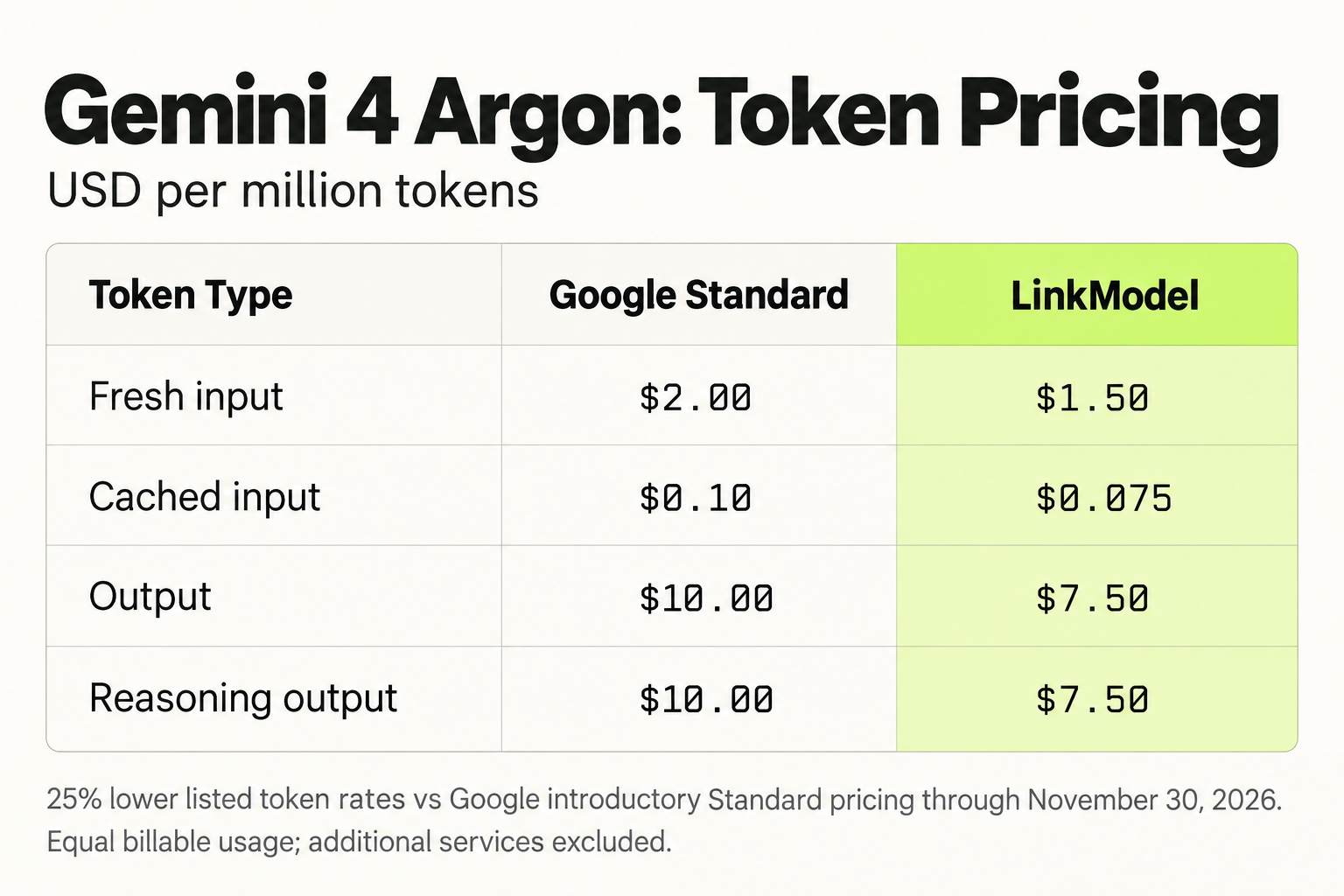
LinkModel’s published Argon rates are 25% below Google’s current Standard rates across fresh input, cached input, output, and reasoning output. The official LinkModel Argon page provides the model-specific price table.
Rates below are per million tokens.
| Token category | Google Standard | LinkModel |
|---|---|---|
| Fresh input | $2.00 | $1.50 |
| Cached input | $0.10 | $0.075 |
| Visible output | $10.00 | $7.50 |
| Thinking / reasoning output | $10.00 | $7.50 |
Google’s output rate includes thinking. LinkModel separately lists output and reasoning output at the same rate. Count each billable token once, even when usage reporting presents reasoning separately.
Argon Request Cost Without Caching: $0.40 vs. $0.30
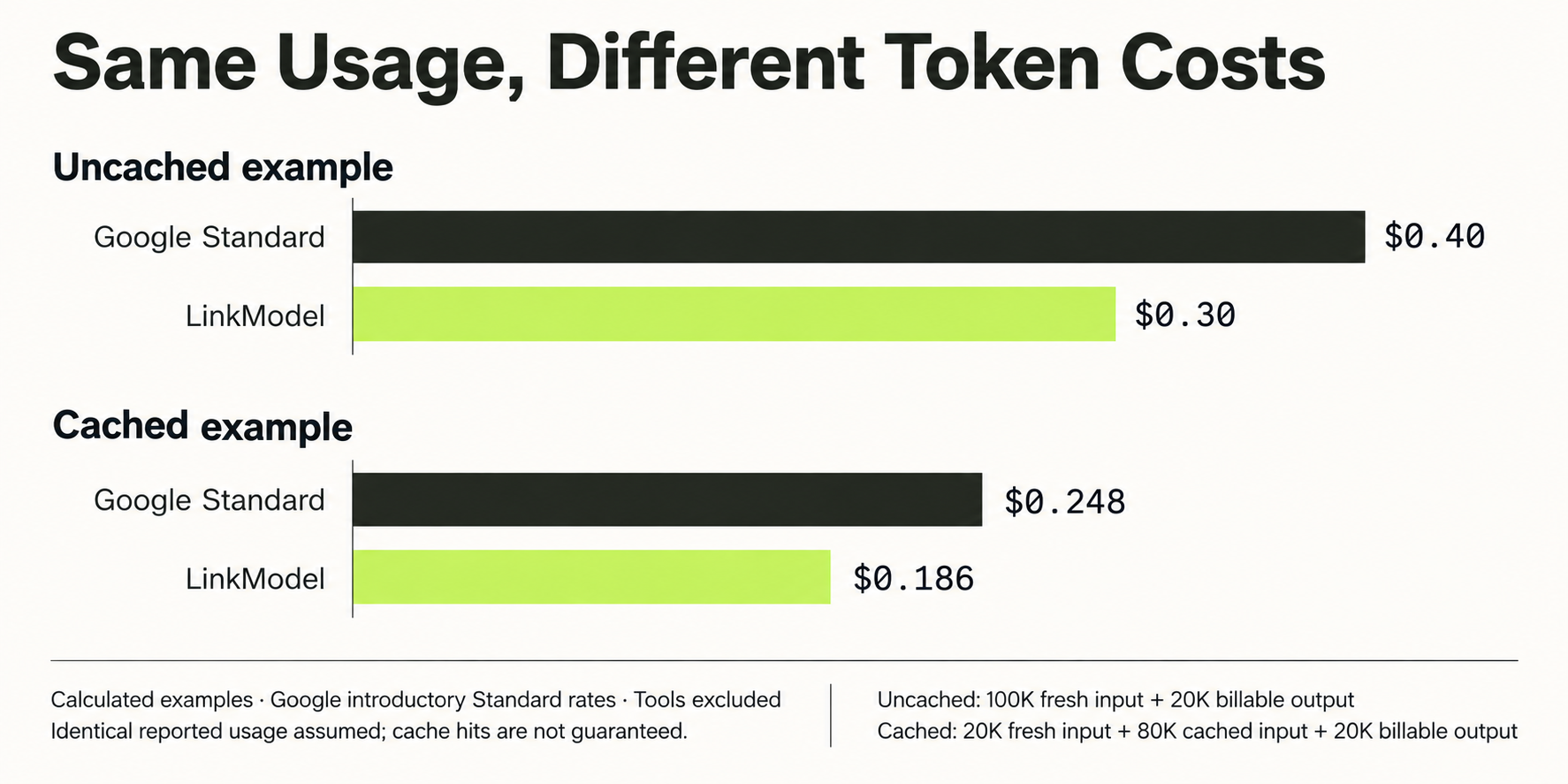
Consider a calculated request using 100,000 fresh input tokens and 20,000 total billable output tokens, including thinking.
| Component | Google Standard | LinkModel |
|---|---|---|
| Fresh input | $0.20 | $0.15 |
| Billable output | $0.20 | $0.15 |
| Token subtotal | $0.40 | $0.30 |
At 10,000 identical requests, that becomes $4,000 versus $3,000, a calculated $1,000 difference.
The comparison assumes identical billable quantities. It excludes separately charged tools, infrastructure, and other services.
Argon Request Cost With Caching: $0.248 vs. $0.186
Now assume the same request contains 20,000 fresh input tokens, 80,000 successfully cached input tokens, and 20,000 billable output tokens.
| Component | Google Standard | LinkModel |
|---|---|---|
| Fresh input | $0.040 | $0.030 |
| Cached input | $0.008 | $0.006 |
| Billable output | $0.200 | $0.150 |
| Token subtotal | $0.248 | $0.186 |
The token subtotal is again 25% lower at equal usage. However, identical prompts do not prove identical cache hits across routes. Apply each route’s reported cached-token quantity when calculating actual spending.
This is the useful boundary of the claim: 25% lower current token rates against Google Standard, rather than a guaranteed reduction in every task’s complete operating cost.
Gemini 4 Argon Token Costs: Thinking and Monthly Budgets
A reliable estimate separates fresh input, cache reads, and total billable output. Then it adds applicable service charges and the billable usage of additional attempts.
For rates expressed per million tokens:
Token cost = (fresh input tokens × input rate + cached input tokens × cache rate + billable output tokens × output rate) ÷ 1,000,000
Fresh input excludes tokens already counted as cache reads. Billable output includes charged thinking exactly once.
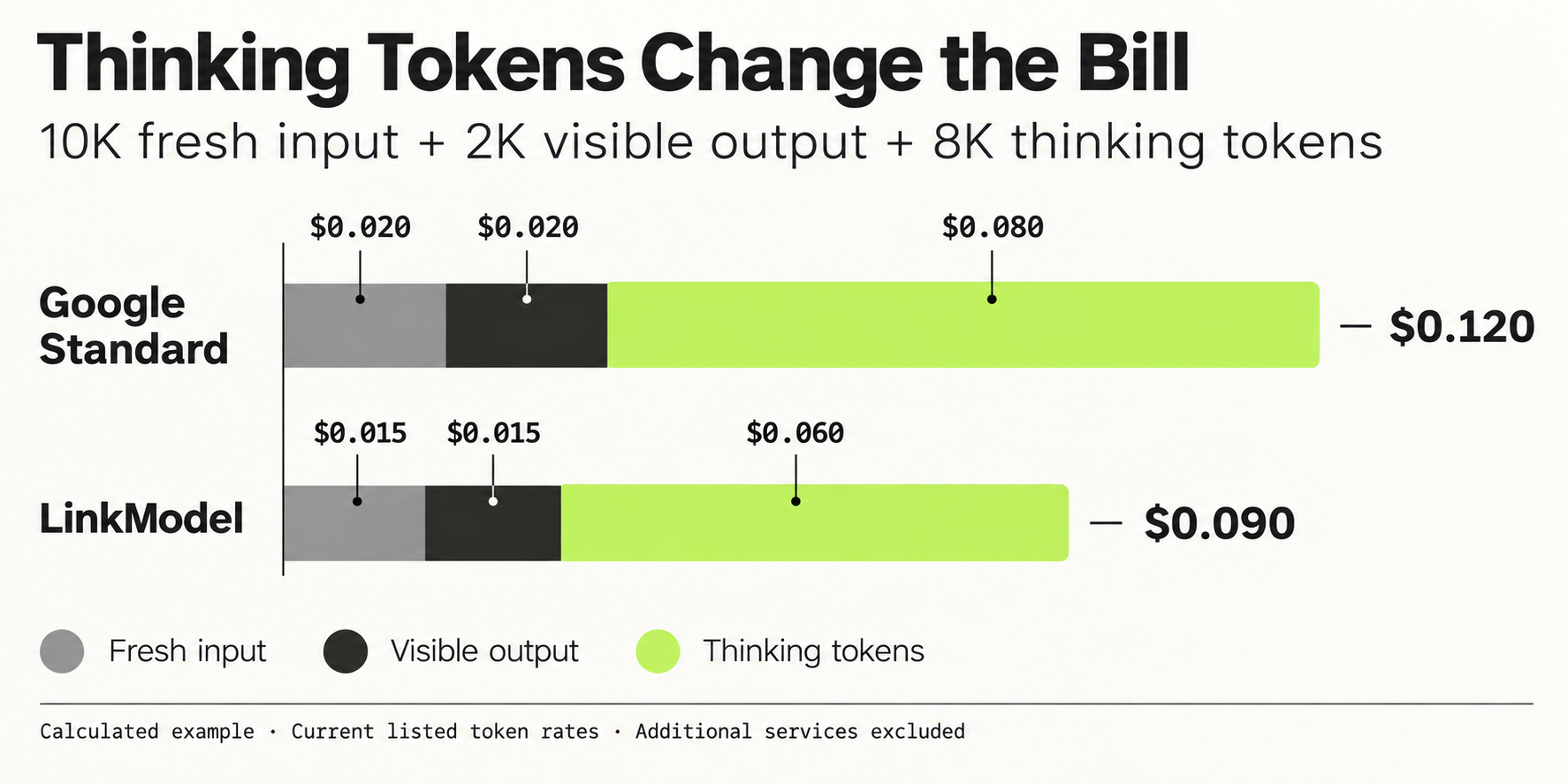
Thinking Token Costs: Why a Short Answer Can Produce a Larger Bill
Google’s Argon model guide confirms that thinking contributes to output billing. The visible response therefore does not necessarily represent the full output cost.
Consider this calculated request:
| Component | Google Standard | LinkModel |
|---|---|---|
| 10K fresh input tokens | $0.020 | $0.015 |
| 2K visible output tokens | $0.020 | $0.015 |
| 8K thinking tokens | $0.080 | $0.060 |
| Total | $0.120 | $0.090 |
At Google’s introductory Standard rates, counting only input and visible output would produce a $0.04 estimate. Thinking accounts for two-thirds of this example’s token cost.
Argon offers low, medium, and high thinking levels, with medium as the default. Use medium as an evaluation baseline, then compare other levels on the same tasks. Select the lowest level that meets the quality requirement without creating excessive retries.
Monthly Argon API Costs: Separate Workload Types
These calculated scenarios assume 10,000 requests, uncached input, identical usage per request, and no separately charged services.
| Tokens per request | Google Standard now | LinkModel current rates |
|---|---|---|
| 10K input + 5K output | $700 | $525 |
| 10K input + 12K output | $1,400 | $1,050 |
| 100K input + 20K output | $4,000 | $3,000 |
Output includes thinking. At Google’s announced December Standard rates, the Google column doubles.
The first two scenarios use identical input quantities, yet their total costs differ by a factor of two. Output behavior matters.
Build separate forecasts for extraction, document analysis, and extended agent work. Update each group with observed token usage before multiplying by production request volume.
Gemini 4 Argon Cache Pricing: What the 95% Discount Actually Saves
Implicit caching discounts successfully reused input, not the entire request. Google’s context caching documentation sets Argon’s minimum input length at 4,096 tokens and recommends placing shared content at the beginning of prompts.
Stable instructions and repeated reference material are useful candidates. Similar prefixes sent close together can improve reuse opportunities, but eligibility does not guarantee a hit.
Cached Input Savings: A 95% Rate Discount Can Mean 38% Request Savings
In the earlier Google Standard example, caching 80,000 of 100,000 input tokens reduced the token subtotal from $0.40 to $0.248.
That is a 38% request-level reduction, despite a 95% reduction in the rate charged for cached input.
At LinkModel’s listed rates, the corresponding calculated subtotal falls from $0.30 to $0.186: also 38%, assuming the same cached quantities.
The lesson is practical: cache savings depend on the share of spending attributable to reusable input. An agent can have excellent cache reuse and still incur substantial reasoning costs.
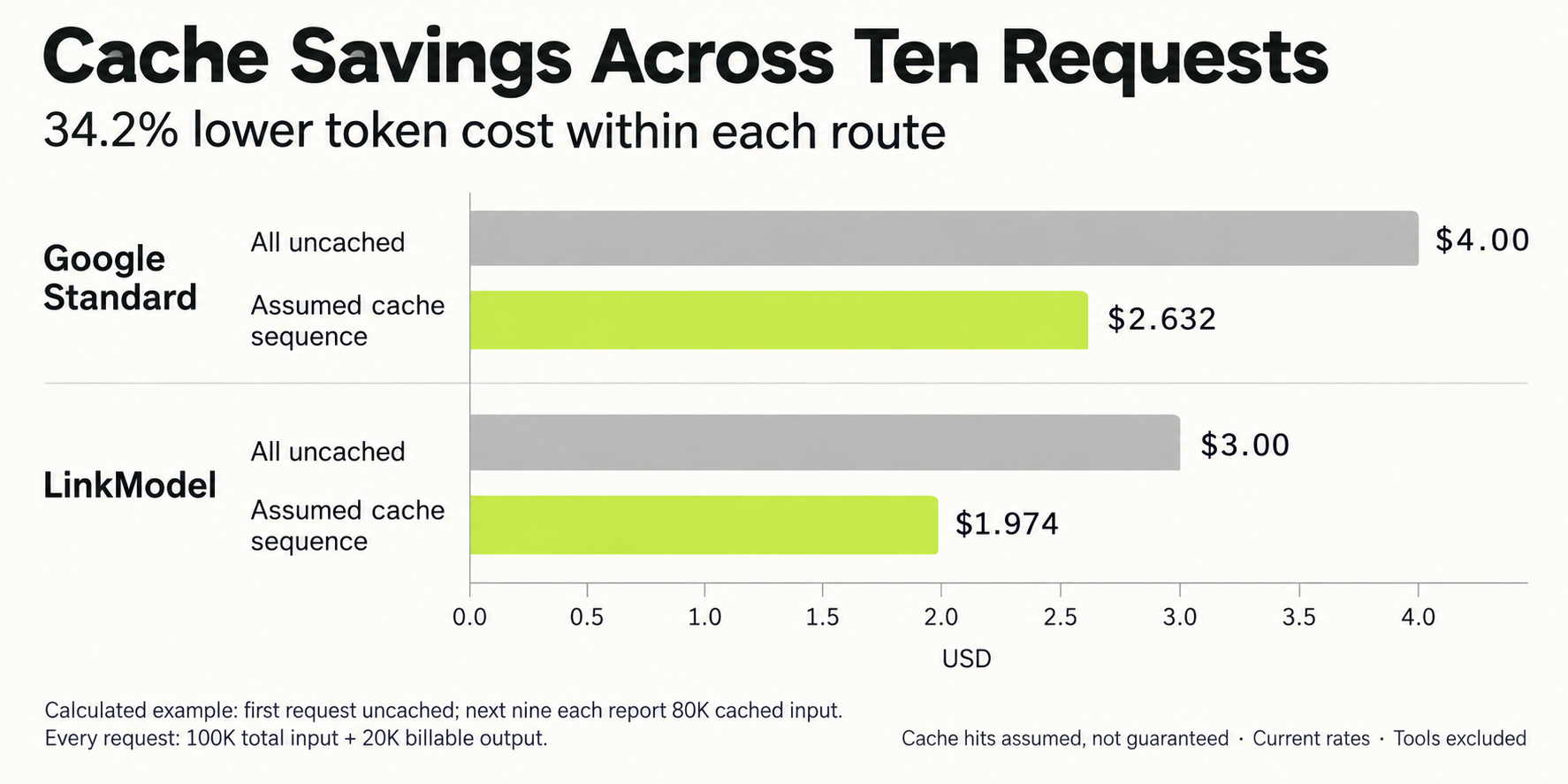
Cache Lifecycle Costs: Include Initial Requests and Misses
Consider ten requests using those quantities. Assume the first is fully uncached and the next nine each report 80,000 cached input tokens.
| Route | Ten uncached requests | Assumed cache sequence |
|---|---|---|
| Google Standard | $4.00 | $2.632 |
| LinkModel | $3.00 | $1.974 |
Each sequence saves 34.2% against its own uncached baseline. The first uncached request lowers the average saving compared with an individual successful-hit request.
Argon supports implicit caching only. Do not apply another model’s explicit cache-write or storage schedule to it. Use actual cache reporting across the whole sequence when forecasting production costs.
Gemini 4 Argon Batch, Flex, and Priority: Which Tier Fits?
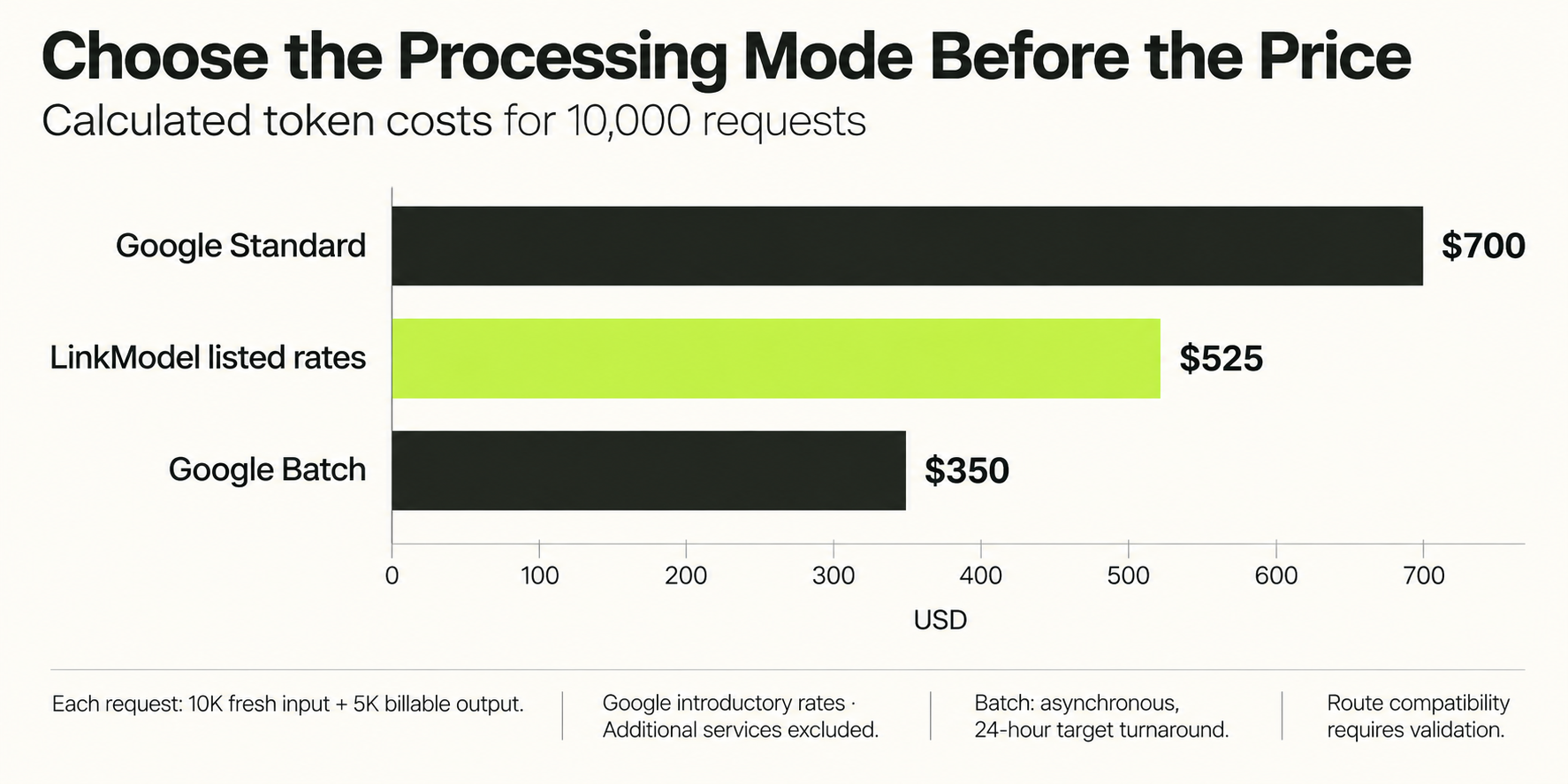
Choose the processing mode before deciding which price comparison matters. Google’s introductory Batch and Flex rates are below its Standard rates and below LinkModel’s current listed token rates, but they carry different execution conditions.
| Workload | Option to evaluate | Main consideration |
|---|---|---|
| Interactive requests | Standard or a suitable gateway route | Response behavior and feature support |
| Independent overnight jobs | Batch | Asynchronous completion |
| Sequential background work | Flex | Waiting time and availability |
| Priority-sensitive work | Priority | Higher token spending |
Batch Pricing: Lower Costs for Work That Can Wait
Google’s Batch API documentation describes asynchronous processing at half the Standard cost, with a target turnaround of 24 hours.
For 10,000 requests using 10K fresh input and 5K billable output tokens each, introductory token spending calculates to:
- Google Standard: $700
- LinkModel current listed rates: $525
- Google Batch: $350
For scheduled classification or evaluations, Batch may offer the better price. A time-sensitive customer interaction has a different requirement.
Flex Pricing: Discounted Sequential Processing With Availability Tradeoffs
Google’s Flex inference guide describes synchronous processing with variable latency, a 1–15 minute latency target, and best-effort availability.
Flex can suit a background agent whose next step depends on the previous response. Capacity shortages can produce errors, and requests do not automatically upgrade to Standard.
For 10K fresh input and 5K billable output tokens, introductory costs calculate to $0.035 on Flex, $0.070 on Standard, and $0.126 on Priority.
Set completion deadlines, timeout handling, and fallback rules before choosing the lowest rate.
Gemini 4 Argon Case Studies: What Counts as Valuable Work?
Our research suggests evaluating Argon through accepted changes and measured outcomes, rather than generated volume alone. Several engineering examples in Google’s launch report provide useful evaluation targets.
Google reports more than 35% growth in agentic code submissions alongside a rollback reduction of nearly one-third. These are distinct measures: activity and downstream quality.
They do not establish a corresponding reduction in API spending, but they help define what a productive evaluation should examine.
Chromium Refactoring: Measure Accepted Repository Changes
Google describes Argon assisting a refactor involving a roughly six-million-line legacy folder within Chromium’s 40-million-line repository, with work reportedly moving from a months-long expectation to completion in weeks.
For a similar task, measure reviewed patches, regression results, and repair effort. Repository size provides context; accepted architectural changes provide the decision metric.
ADK and Gemma Optimization: Keep Performance Gains in Context
Google reports 40% lower session preparation time and 21% faster cold imports from Argon-assisted ADK optimization.
It also reports using Argon to raise Gemma 4 E2B throughput from approximately 37,900 to more than 108,000 tokens per second on an A100, with token parity. That throughput belongs to the optimized Gemma system, not the Argon API.
For an optimization project, preserve the same workload and correctness checks before and after the change. Compare accepted performance improvements with API spending and review effort.
Gemini 4 Argon Benchmarks and Cost Per Accepted Result
A benchmark can identify a model worth evaluating; it cannot predict your application’s success rate. The Vals Index leaderboard, dated October 13, 2026, reports:
| Model | Vals Index |
|---|---|
| Gemini 4 Argon | 68.90% |
| Claude Sonnet 5.5 | 67.04% |
| Claude Opus 5.5 | 66.97% |
The index weights professional tasks across finance, coding, legal, and tax. Its methodology also describes fallback handling for some competing-model results.
Argon’s lead makes it a relevant candidate for professional workflows. It does not imply that 68.90% of your production tasks will succeed.
Accepted-Result Costs: Include Retries and Corrections
Cost per accepted result = total API spending across attempts ÷ accepted results
In a calculated evaluation, 100 requests costing $0.12 each produce $12 in token spending. If 80 results pass, that is $0.15 per accepted result. If only 60 pass, it becomes $0.20.
Our review of user questions about Argon surfaced interest in tokens per task, retries, debugging, and cleanup. Those are useful evaluation questions, rather than evidence of a measured success rate.
For generated software, acceptance should include working integrations, persistent data, error handling, and the required business outcome. A polished interface alone does not establish completion.
Using Gemini 4 Argon on LinkModel: Access, Billing, and Compatibility
LinkModel lists Argon as available and documents an OpenAI-compatible Chat Completions interface. Its Chat Completions reference describes bearer-key authentication, streaming, and usage reporting, with feature support dependent on the selected model and provider.
For a first integration:
1. Obtain a LinkModel API key.
2. Select Gemini 4 Argon and use the model identifier provided by its API interface.
3. Send a short representative text request.
4. Record input, output, reasoning, and cache usage where reported.
5. Compare the corresponding charge with the published rates.
Start with a small, bounded workload before moving an agent’s full production traffic.
Argon Compatibility: Separate Model Capabilities From Route Support
The LinkModel Argon integration notes explicitly caution against assuming Google’s Interactions API, background Long Decode, implicit caching, or provider-specific tool fields pass through unchanged.
Validate the features your application needs individually: streaming, structured output, function calling, multimodal input, reasoning controls, and long output.
A listed cache rate establishes how that billing category is priced. It does not guarantee that every request or integration will produce a cache hit.
Grounding and Long Decode: Budget Beyond Ordinary Text Requests
Google’s pricing schedule includes a shared Search grounding allowance, followed by $14 per 1,000 billable searches. One model request can trigger multiple search queries. For example, 2,000 billable queries beyond the allowance add $28, before token charges.
The official Argon specification lists a 1,048,576-token shared window and a 65,536-token default synchronous output limit. Input, thinking, and output share that capacity.
Google’s long-decode guidance describes background execution for longer generation. Confirm equivalent route support before designing around it, and set a generation allowance that matches the deliverable.
Frequently Asked Questions
How Much Does Gemini 4 Argon API Cost Now and After November?
Google Standard costs $2 per million fresh input tokens, $0.10 per million cached input tokens, and $10 per million output tokens, including thinking, through November 30, 2026. Those rates double on December 1. LinkModel currently lists $1.50 input, $0.075 cached input, and $7.50 output or reasoning output.
Does LinkModel Really Save 25% on Gemini 4 Argon?
Its current published token rates are 25% below Google’s introductory Standard rates. At identical billable quantities, the model-token subtotal is 25% lower. Tool charges, different cache hits, retries, and processing modes can change complete-task savings.
Why Can a Short Argon Answer Cost More Than Expected?
Thinking contributes to output billing. Estimate from total reported billable usage, including reasoning, rather than visible response length. Additional attempts and tool usage can increase spending further.
Does Argon Caching Automatically Reduce the Whole Bill by 95%?
No. The 95% discount applies to successfully cached input tokens. Google sets a minimum input length of 4,096 tokens for eligibility, and cache hits are not guaranteed. Fresh input and output remain separately billable.
Do I Need a Consumer Subscription to Use the Argon API?
Consumer subscriptions and developer API access are different purchasing routes. Google’s API access guidance states that Argon is unavailable on the API Free tier. LinkModel provides a separate API-key route; consumer-plan access should not be treated as an included API token balance.
Conclusion
Gemini 4 Argon is easiest to budget when fresh input, cache reads, and output including thinking are counted separately, then connected to accepted results. Choose Batch or Flex when their processing conditions fit, account for Google’s December price change, and validate the features your application depends on. LinkModel’s current $1.50 input, $0.075 cached-input, and $7.50 output or reasoning rates are 25% below Google’s introductory Standard token prices, offering a concrete cost advantage for developers ready to evaluate Argon on a representative workload.