GPT-6 Astra outperforms GPT-5.6 Sol on several demanding agentic benchmarks, while GPT-5.6 Sol remains less expensive for routine coding, writing, and high-volume API workloads. Astra scores 57.9% versus 37.3% on Terminal-Bench 4.0, but its OpenAI Standard short-context input and output rates are 2.5× higher. The better choice depends on whether Astra's additional capability reduces failures, retries, and human correction.
This comparison examines published coding benchmarks, long-context performance, API pricing, and reported developer workflows. It also explains why cost per successful task is often more useful than cost per million tokens. Since newer GPT-6 Sol models are now available, the recommendations here apply specifically to GPT-6 Astra and GPT-5.6 Sol.
For developers considering alternative API providers, LinkModel lists GPT-6 Astra at $7.50/M input and $37.50/M output for short-context text requests—25% below OpenAI's corresponding Standard rates. LinkModel offers a unified API for supported models, although available features differ by model and provider route. Developers should verify tool support before choosing a route for agentic workflows.

GPT-6 Astra vs GPT-5.6 Sol: Quick Answer
For API comparisons, GPT-5.6 primarily means GPT-5.6 Sol because OpenAI states that the GPT-5.6 alias routes requests to Sol.
| Factor | GPT-6 Astra | GPT-5.6 Sol |
|---|---|---|
| Best suited for | Difficult reasoning and agentic tasks | Routine coding and repeatable workloads |
| OpenAI Standard input | $10/M | $4/M |
| OpenAI Standard output | $50/M | $20/M |
| Context window | 1.05M | 1.05M |
| Maximum output | 128K | 128K |
| Terminal-Bench 4.0 | 57.9% | 37.3% |
| DeepSWE v1.1 | 74.1% | 72.7% |
Quick verdict: Choose GPT-5.6 Sol when it completes your existing workload reliably at a lower cost. Consider GPT-6 Astra for difficult reasoning, complex debugging, and agentic tasks where failures are expensive. These recommendations concern model capability; API-provider feature support must be checked separately. For new deployments, also benchmark newer models before committing to GPT-5.6 Sol.
The practical decision is straightforward for AI API pricing comparisons:
- Use Sol by default when the task is predictable and inexpensive to retry.
- Use Astra first when failure, supervision, or incomplete execution is expensive.
- Escalate from Sol to Astra when validation fails or the task becomes agentic.
- Compare cost per completed task, not only price per million tokens.
What Changed From GPT-5.6 Sol to GPT-6 Astra?
GPT-6 Astra is designed for the hardest end-to-end work, while GPT-5.6 Sol is a lower-cost flagship model for complex professional tasks. Both can write code, use tools, process large contexts, and produce professional content, but Astra places more emphasis on autonomous execution and sustained problem-solving.
Astra Is an Agent Upgrade
Astra’s clearest advantage appears when a task requires the model to explore an unfamiliar environment, select tools, diagnose the root cause, make changes, validate the result, and recover from an unsuccessful attempt.
That is different from asking for an explanation, isolated function, short report, or clearly specified edit. Sol already handles many of those tasks effectively.
In our research, Astra created the most value when it needed to inspect unfamiliar repositories, identify architectural causes, coordinate several actions, or continue working without constant human direction. Sol remained competitive when the implementation path was already clear.
Astra is therefore a stronger completion engine for difficult workflows, not simply a more expensive version of Sol.
Astra and Sol Have the Same Context Capacity
Both models support a 1,050,000-token context window and up to 128,000 output tokens. Earlier comparisons sometimes described Sol as having a smaller context window, but current official documentation no longer supports that distinction.
The difference is how effectively each model uses large context. Astra becomes more valuable when requirements, source files, logs, previous failures, and tool results are distributed across hundreds of thousands of tokens.
OpenAI’s GPT-6 Astra documentation lists five reasoning levels from low through max, while the GPT-5.6 Sol documentation also includes a none setting. Both support major Responses API capabilities, although individual API providers may expose a narrower feature set.
GPT-6 Astra vs GPT-5.6 Benchmarks
The most useful comparison is not the average benchmark score. It is the size of Astra’s advantage for each type of work.
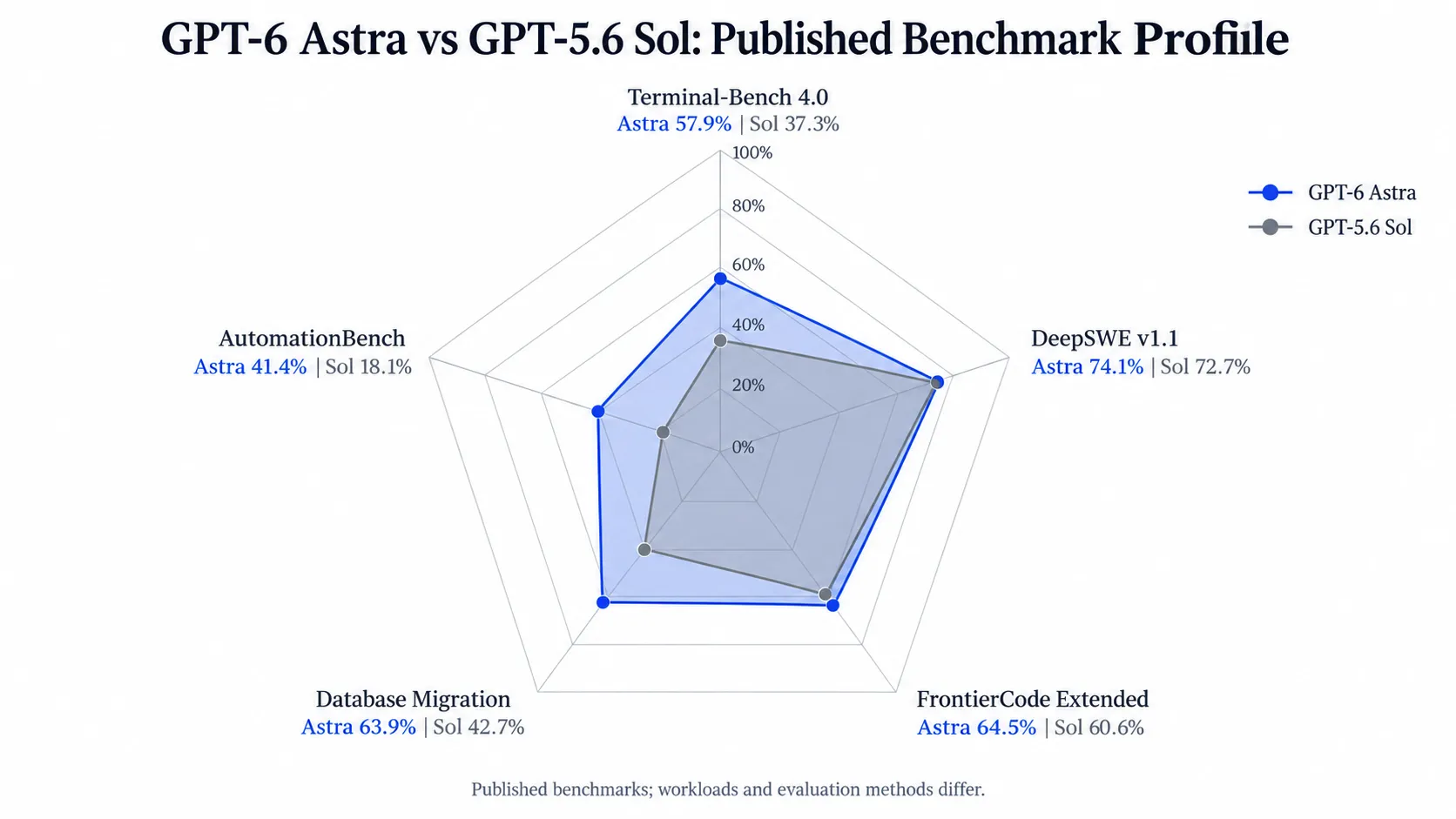
| Benchmark | Astra | Sol |
|---|---|---|
| Terminal-Bench 4.0 | 57.9% | 37.3% |
| DeepSWE v1.1 | 74.1% | 72.7% |
| FrontierCode Extended | 64.5% | 60.6% |
| Database Migration | 63.9% | 42.7% |
| AutomationBench | 41.4% | 18.1% |
| OSWorld 2.0 | 72.6% | 65.7% |
OpenAI’s GPT-6 Astra evaluation report publishes these results under specific model, reasoning, tool, and agent-harness configurations. They provide controlled evidence but do not guarantee the same results in every application.
Agentic Work Shows the Largest Gains
Astra's largest published gains appear in agentic execution: 57.9% vs 37.3% on Terminal-Bench 4.0, 63.9% vs 42.7% on Database Migration, and 41.4% vs 18.1% on AutomationBench. These results suggest a meaningful advantage when tasks require multiple dependent actions rather than a single generated answer.
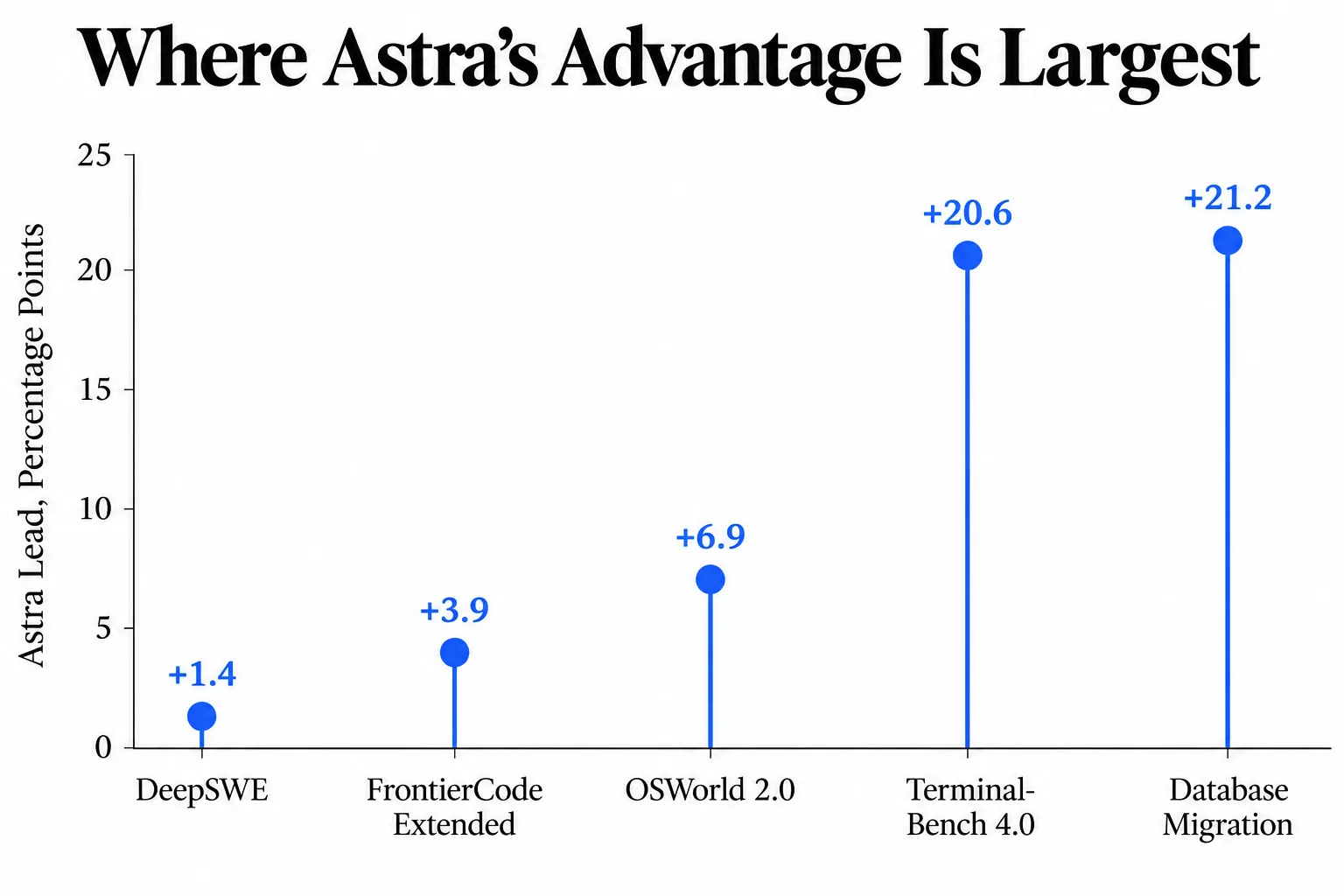
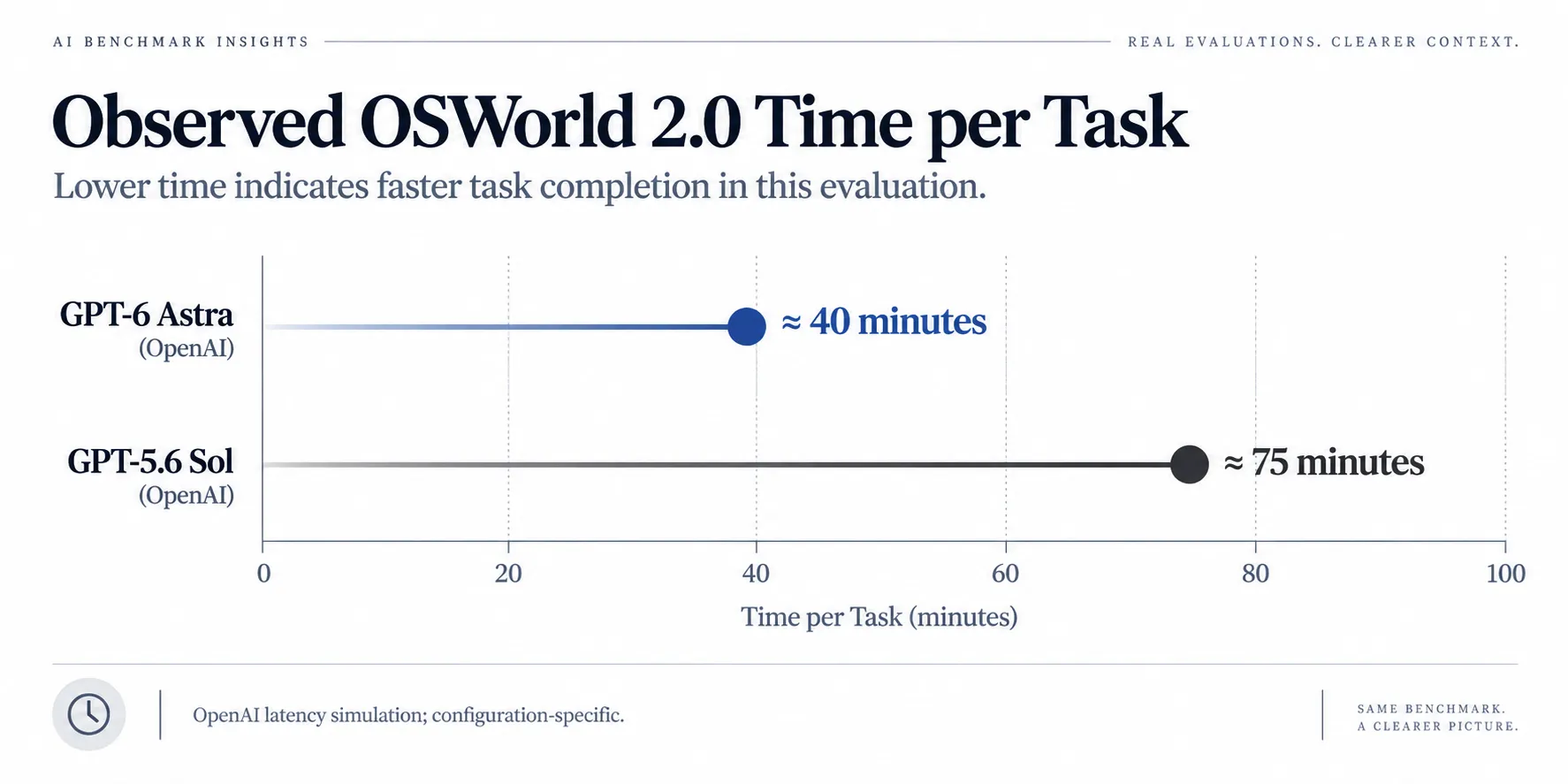
On OSWorld 2.0, Astra scored 72.6% versus 65.7% and completed tasks in approximately 40 versus 75 minutes under the reported evaluation setup. That makes Astra worth considering when execution time and human supervision matter, although benchmark results do not guarantee equivalent gains in production.
Ordinary Coding Shows a Smaller Difference
For conventional coding, the gap is narrower. Astra scored 74.1% vs 72.7% on DeepSWE v1.1 and 64.5% vs 60.6% on FrontierCode Extended. These differences are smaller than its advantages on terminal, migration, and automation tasks.
The distinction matters for API economics: a more capable model is not automatically the more cost-effective choice. For predictable refactoring, implementation, or test generation, Sol may deliver comparable accepted results at a lower token price. Actual performance depends on the evaluation harness and workload.
Astra Pulls Ahead in Difficult Long-Context Work
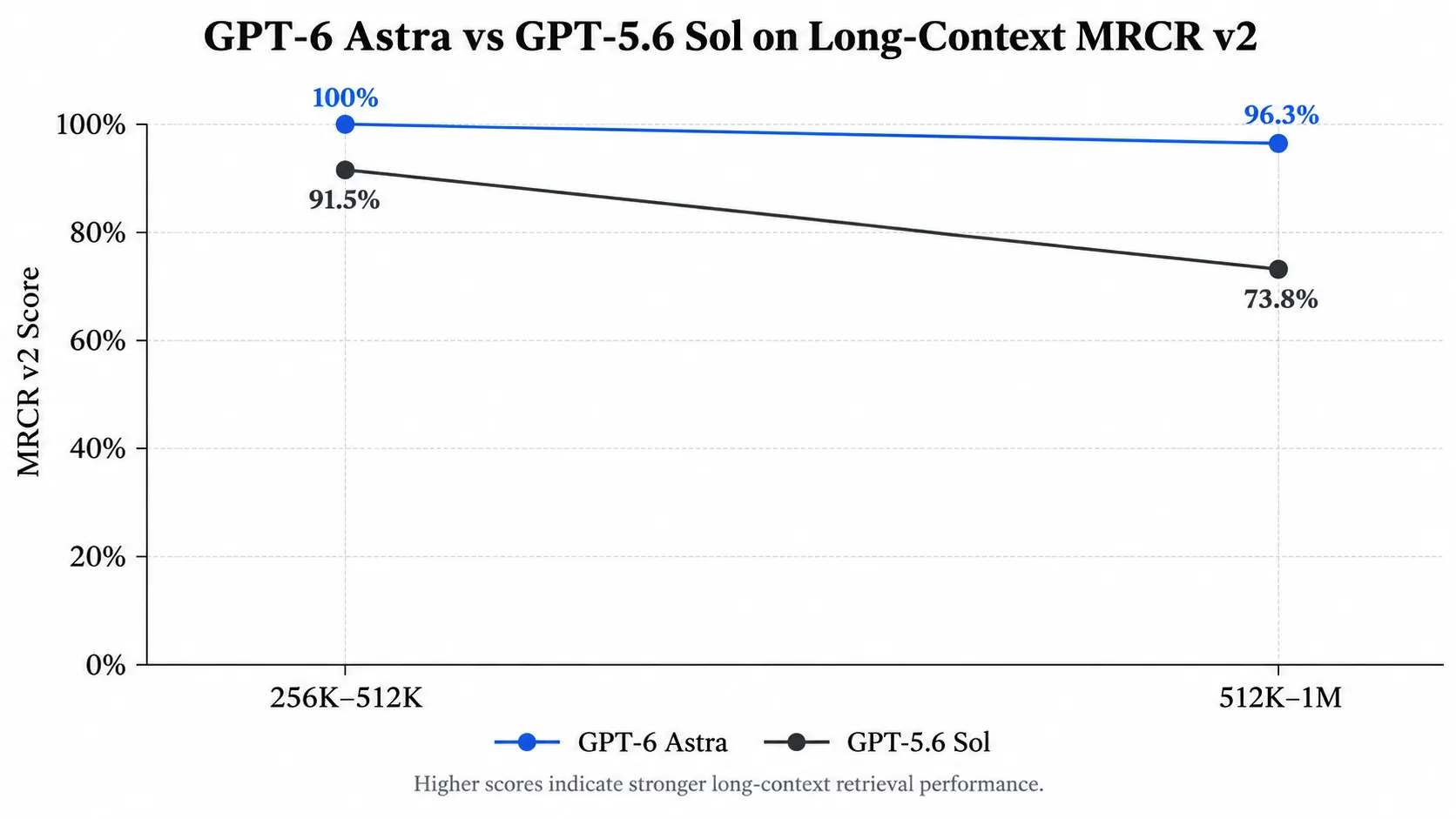
OpenAI’s MRCR v2 results show a larger difference in the longest context range.
| Context range | Astra | Sol |
|---|---|---|
| 256K–512K | 100% | 91.5% |
| 512K–1M | 96.3% | 73.8% |
Both models support approximately 1.05 million context tokens, but Astra performed better on the published MRCR v2 long-context evaluation, particularly at 512K–1M tokens (96.3% vs 73.8%). This suggests stronger retrieval across widely separated information, not a larger context window. However, longer inputs can trigger higher pricing tiers, so developers should measure whether the added context actually improves task completion.
Is GPT-6 Astra Better for Coding?
Astra is generally better for difficult agentic coding, architecture diagnosis, and unfamiliar repositories. Sol remains a strong daily coding model and can perform better in specific review or implementation workflows.
Difficult Debugging and Architecture Favor Astra
In a reported debugging workflow, Sol struggled to complete a remote-stash hotkey feature, while Astra found a workable implementation path. Another comparison reported a smaller Astra code change—approximately 120 lines added and 200 removed, versus 400 added and 100 removed for Sol. These observations suggest potential benefits in unfamiliar codebases, but neither example establishes a general coding advantage without matched task conditions and independent validation.
Sol Can Remain Better for Code Review
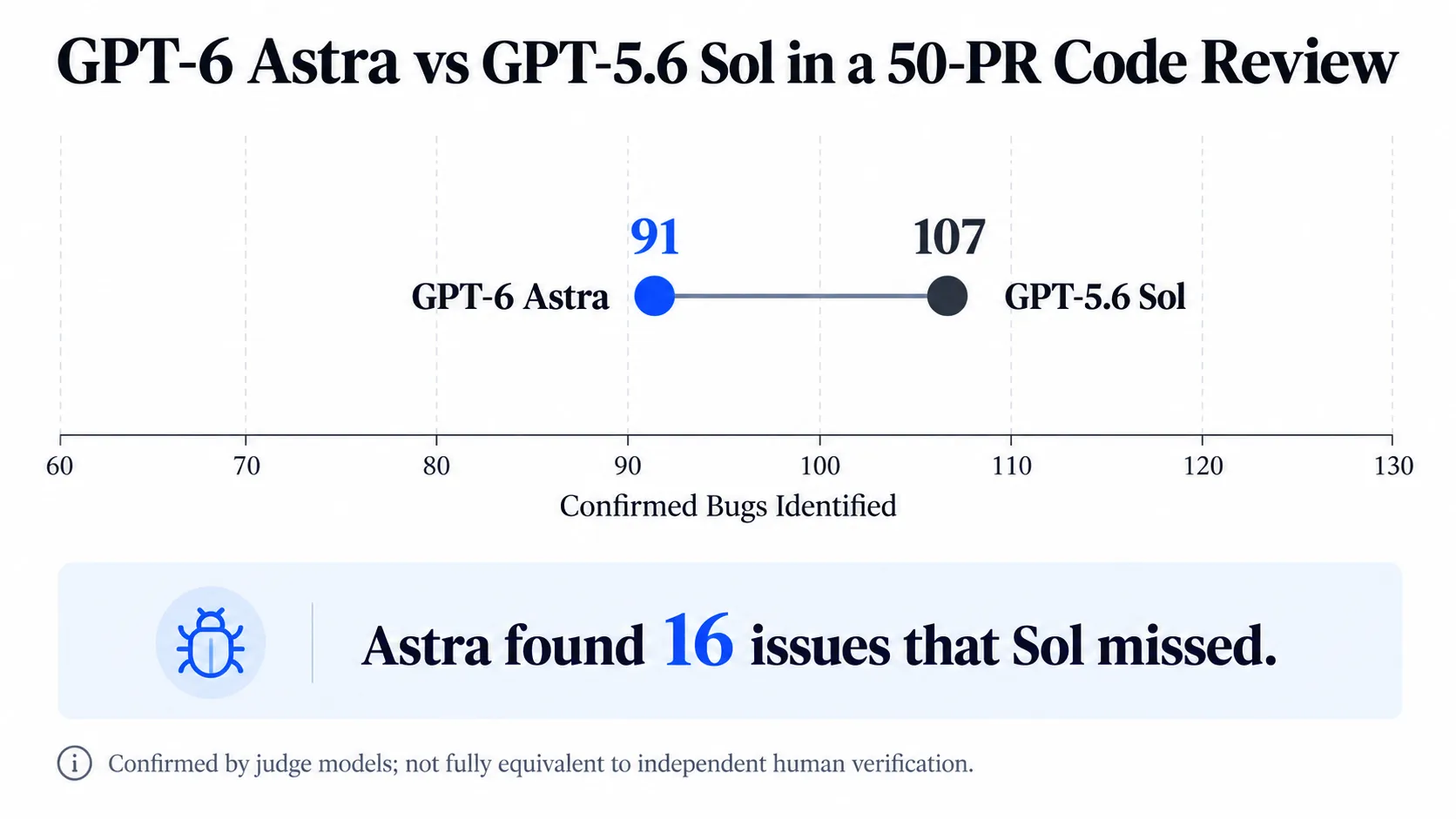
A third-party evaluation of 50 pull requests reported 107 identified bugs for Sol versus 91 for Astra, while Astra found 16 issues Sol missed. Because the results relied on model-based judging rather than complete independent human verification, they should be treated as evaluation-specific evidence. The findings nevertheless support testing Sol as an independent reviewer instead of assuming Astra is better at every coding task.
Large Repositories Favor Role Separation
One reported repository audit used six Astra Ultra analysis runs, a Max implementation run, and three Ultra red-team reviews. Over approximately 3.5 hours, the reported weekly allowance fell from 39% to 26%. This illustrates the potential cost of using high-reasoning agents throughout an entire workflow. A more efficient approach is to reserve Astra for architecture and root-cause analysis, use lower-cost models for implementation, and validate the final result independently.
GPT-6 Astra vs GPT-5.6 API Pricing
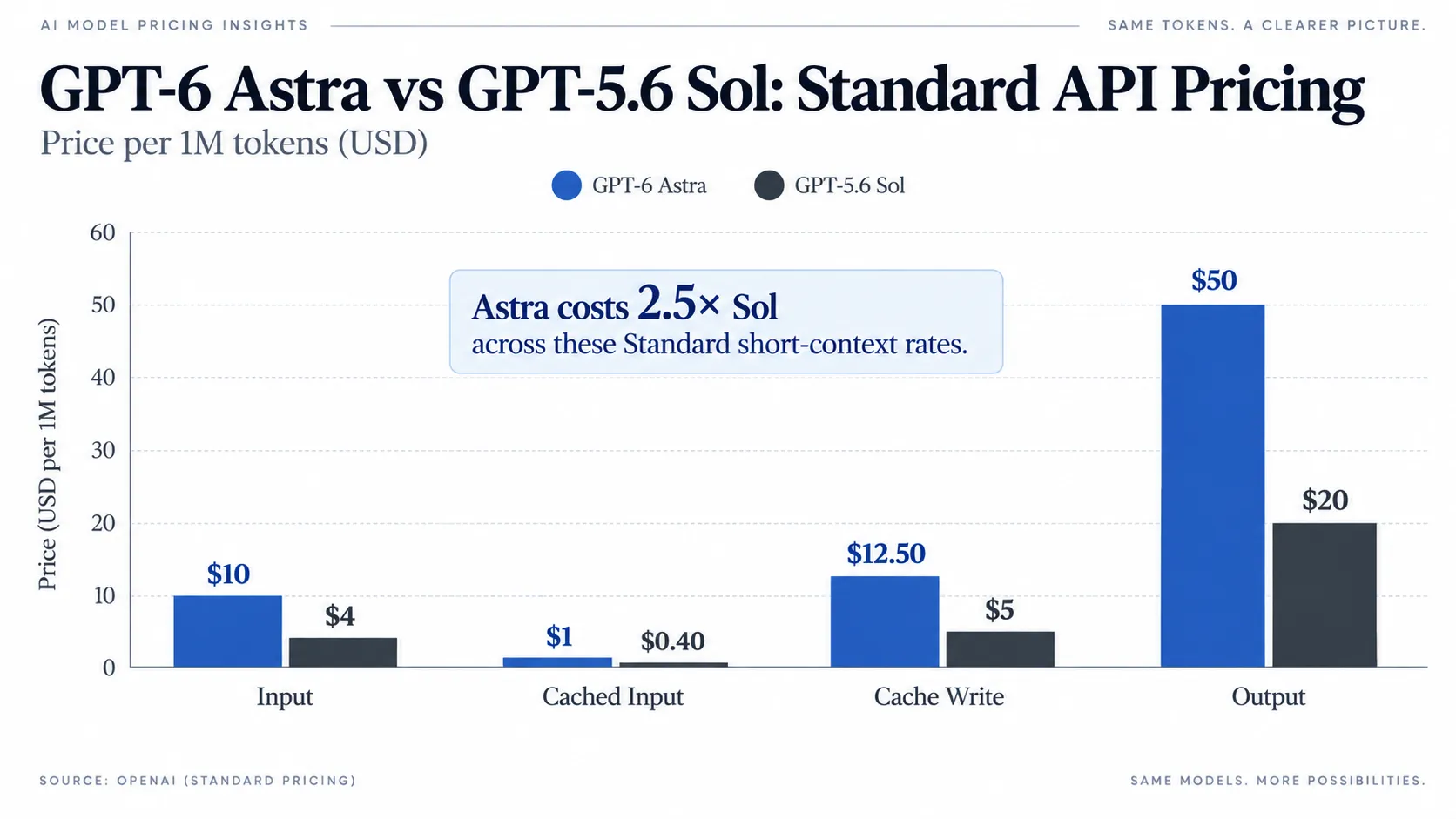
At OpenAI's published Standard short-context rates, GPT-6 Astra costs 2.5× GPT-5.6 Sol per input or output token. However, developers can also compare provider-specific rates. LinkModel currently lists Astra at 25% below OpenAI's corresponding Standard token prices for supported text requests.
The following prices are in USD per million tokens and apply to requests with no more than 272K input tokens.
| Token type | OpenAI Astra | LinkModel Astra | OpenAI GPT-5.6 Sol |
|---|---|---|---|
| Fresh input | $10.00 | $7.50 | $4.00 |
| Cached input | $1.00 | $0.75 | $0.40 |
| Cache write | $12.50 | $9.375 | $5.00 |
| Output | $50.00 | $37.50 | $20.00 |
Pricing notes: These are published token rates, not guaranteed total request costs. Requests exceeding 272K input tokens enter higher long-context pricing tiers. GPT-5.6 Sol's promotional pricing is currently stated to remain available at least through November 21, 2026. LinkModel's listed Astra prices apply to its supported route and should not be interpreted as a guarantee of feature parity with OpenAI's direct API.
Sol’s current promotional pricing is listed as available at least through November 21, 2026, so the comparison should be checked again after that date.
API Cost Example: Astra vs Sol and LinkModel
For a request using 100,000 uncached input tokens and 10,000 output tokens, the estimated costs are:
- OpenAI GPT-6 Astra: $1.50
- LinkModel GPT-6 Astra: $1.125
- OpenAI GPT-5.6 Sol: $0.60
At the same token volume, LinkModel reduces Astra's estimated token cost by 25% compared with OpenAI Standard, saving $0.375 per request. Across 10,000 identical requests, the calculated difference would be $3,750.
GPT-5.6 Sol remains cheaper in this example. Astra becomes economically attractive when its stronger capabilities reduce retries, failed attempts, or manual correction enough to offset the higher token cost. These calculations exclude tool charges, caching effects, and any differences in model token consumption.
Cost per Completed Task Matters More
In the Artificial Analysis index version reviewed on September 15, 2026, Astra Max cost \$7.09 per coding-agent task, approximately 15% more than Sol Max, while scoring seven points higher. Astra used roughly one-third as many tokens per task in that evaluation.
Its broader Intelligence Index produced a different result. Astra Max cost \$3.26 per task, compared with approximately \$1.99 for Sol Max. Astra scored 53 versus 47 but remained more expensive.
These are evaluation-specific results, not universal API costs. They show that model economics change with the workload, reasoning level, agent harness, tool use, and required output.
Cost per successful task equals total model and tool cost divided by accepted results.
Real Workflows Can Reverse the Price Comparison
Our review of a published 11-day usage log covering approximately 6,500 Codex requests and 670 million tokens found that Astra averaged a 61.2K-token prompt, 417 output tokens, and approximately \$0.167–\$0.174 per request. Sol averaged a 137.8K-token prompt, 831 output tokens, and approximately \$0.155 per request.
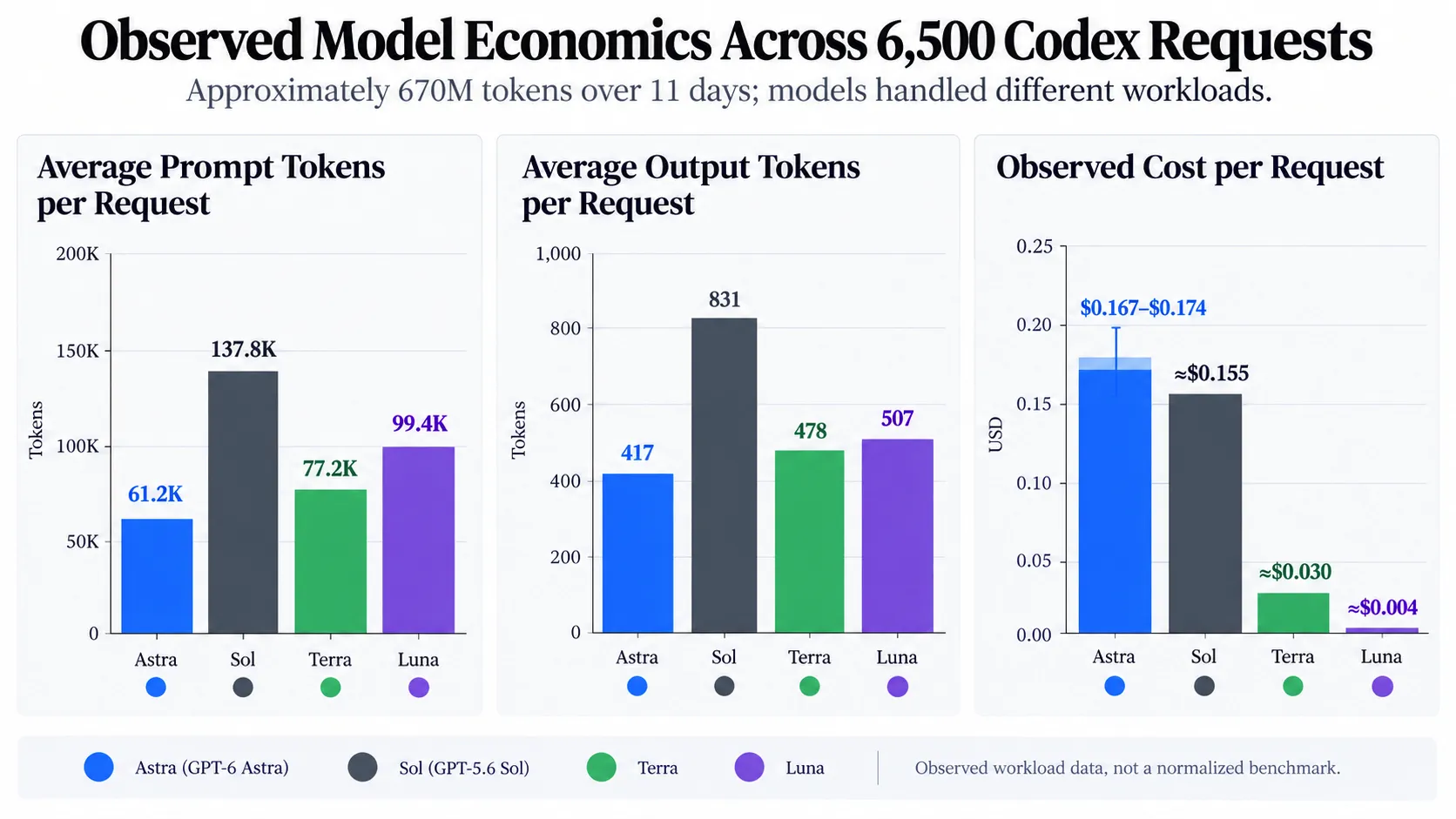
The models handled different tasks, so the log is not a normalized benchmark. It still shows how lower token consumption can narrow Astra’s per-request premium.
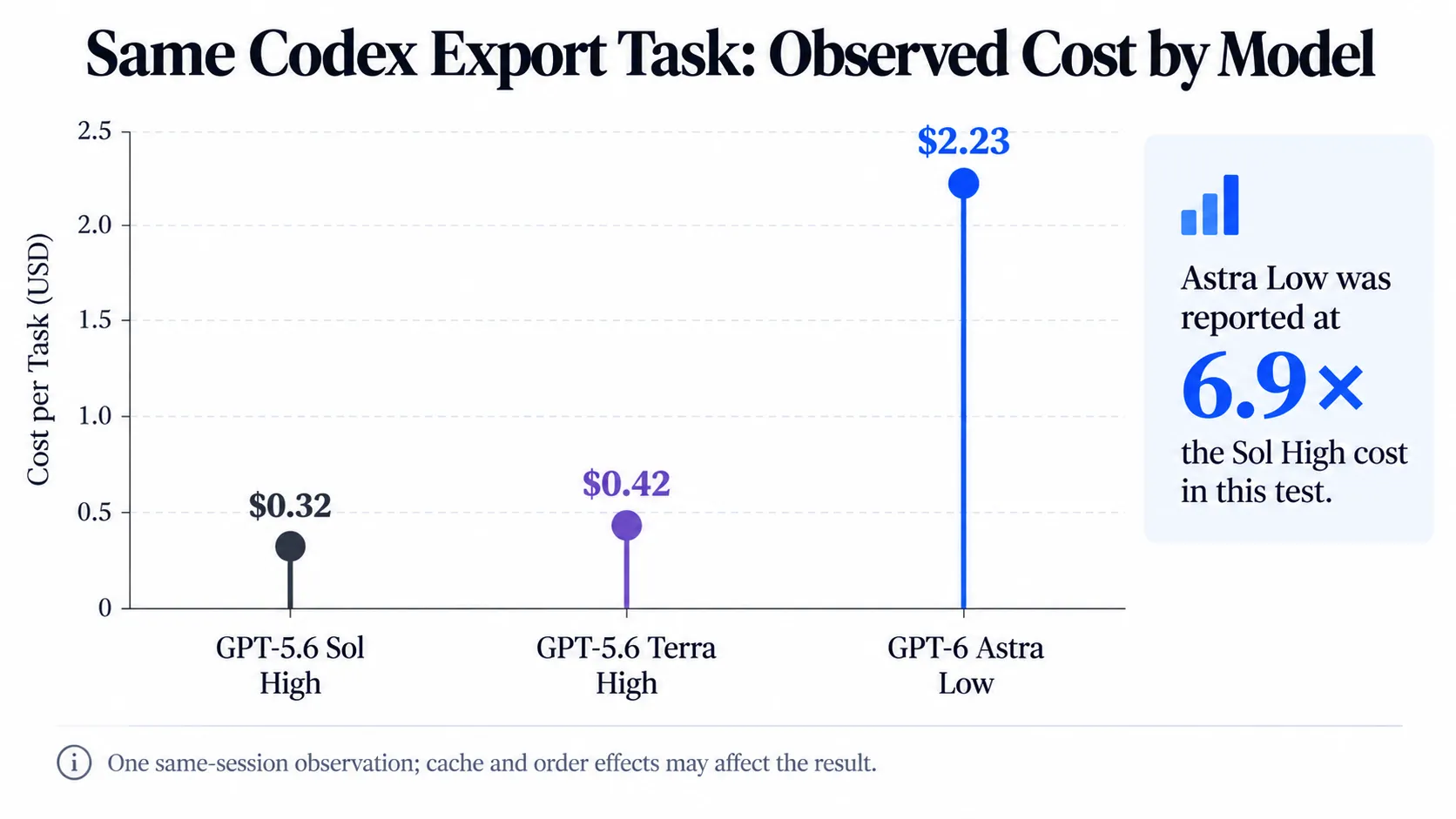
The opposite occurred in a simple conversation-export workflow. Astra Low cost \$2.23, Sol High cost \$0.32, and Terra High cost \$0.42. Astra was approximately 6.9× the Sol cost for a task that did not require frontier-level reasoning.
This is where Astra becomes wasteful: high capability applied to low-complexity work. Teams running large workloads can also reduce spend through AI API cost optimization.
On LinkModel, GPT-6 Astra is priced at \$7.50/M input and \$37.50/M output for short-context usage, equivalent to 75% of OpenAI’s corresponding Standard token rates.
Why Does GPT-6 Astra Consume Quota So Quickly?
API token charges and ChatGPT or Codex subscription allowances are different systems. A percentage of a weekly allowance cannot be reliably converted into an API invoice.
Reasoning Effort Can Expand the Workflow
Astra supports low, medium, high, xhigh, and max reasoning. Higher settings can increase exploration, verification, tool calls, output tokens, and elapsed time.
In one long coding workflow reviewed during our research, approximately 15 minutes of Astra Medium consumed a five-hour allowance, followed by another 30 minutes that exhausted the reported weekly allowance. Two resets were used without completing the task.
Another single-page workflow using Astra High reportedly consumed an entire five-hour window. These are individual workflow observations rather than official quota rules, but they demonstrate why high reasoning should not become the automatic default.
Higher Reasoning Is Not Automatically Better
Our review found that Astra Low or Medium often provided the best balance for debugging and orchestration. High or max was more appropriate when a task required repeated verification, unfamiliar architecture, or expensive failure recovery.
In one orchestration comparison, Astra Low completed the workflow approximately 41% faster than Sol High. However, Astra still missed a timeout-liveness bug that Sol detected.
Faster completion and stronger overall reasoning did not eliminate the value of a second-model review. Reasoning effort should be increased after a validation failure—not simply because a higher setting is available.
The Best GPT-6 and GPT-5.6 Model Routing Strategy
The most cost-effective strategy is not selecting one permanent winner. It is assigning models to different roles and escalating only when necessary.
Use Sol as the Daily Driver
Sol is the better starting point for:
- Routine coding
- Clear feature implementation
- Documentation and writing
- Predictable analysis
- High-volume API workloads
- Independent code review
- Tasks that already pass validation consistently
Sol’s lower token price gives it a clear advantage when it can complete the request without repeated failures.
Use Astra as the Escalation Model
Astra is the stronger starting point for:
- Unknown root causes
- Repository-wide reasoning
- Database migrations
- Complex computer use
- Multi-tool workflows
- Cross-document analysis
- Tasks that repeatedly fail with Sol
- High-value work requiring less human correction
A practical routing policy is to start with the lowest-cost model likely to succeed, validate the result, and escalate to Astra when the output fails a test or crosses a predefined risk threshold.
Model Routing Can Reduce Usage
One workflow in our research used Astra for difficult reasoning and Sol helpers for routine subtasks. The reported usage rate fell by approximately 50%, extending an estimated one-to-two-day working window to roughly three or four days.
Parallelism alone was less effective. Another workflow ran five worktrees using Sol for difficult tasks, Terra for medium tasks, and Luna for simple tasks. It consumed approximately 50% of a five-hour allowance, yet none of the five tasks finished—a useful reminder when deciding how to choose an LLM for different workload tiers.
More active agents did not create more completed work. The correct optimization target is validated task completion—not token throughput, agent count, or visible activity.
For teams evaluating model routing, LinkModel provides a unified API for supported models, including GPT-6 Astra and GPT-5.6 Sol. Its Astra text-token pricing is 25% below OpenAI's corresponding Standard rates. However, LinkModel's current Astra listing is limited to text-only chat and does not expose tool calling or computer-use features, so agentic routing strategies should be tested only on API routes that support the required capabilities.
Who Should Choose Astra or Sol?
Choose GPT-6 Astra If You Need
Choose Astra when your work depends on difficult root-cause analysis, autonomous execution, database migration, repository-wide reasoning, long-context retrieval, or repeated tool use.
It is particularly valuable when failed runs create expensive engineering time, delayed releases, broken workflows, or repeated human correction.
Choose GPT-5.6 Sol If You Need
Choose Sol when you need a reliable daily coding model, predictable professional writing, clear feature implementation, lower token prices, or sustained high-volume usage.
Sol is also useful as an independent reviewer after Astra completes a difficult task because its different behavior may reveal edge cases that Astra overlooked.
Use Both for Production Workloads
Teams should evaluate both models on the same representative task set and measure:
- Successful completion rate
- Input, cached, and output tokens
- Tool actions
- Retry count
- Elapsed time
- Human correction time
- Cost per accepted result
Astra should become the default only for workload categories where these measurements show a material improvement.
FAQ
Is Astra Much Better Than Sol?
Astra is substantially better on some agentic, migration, computer-use, and long-context tasks, but only slightly better on several conventional coding evaluations. It should not automatically replace Sol for every request.
Is Astra Worth 2.5× More?
Astra is worth the higher token price when it measurably reduces retries, failed runs, completion time, or human correction. If Sol already completes the workload reliably, Sol is usually more economical.
Should I Use Astra Low or Sol High?
Start with Sol High for clear implementation and Astra Low for difficult diagnosis or tool-heavy workflows. Test both on the same tasks because reasoning levels are not directly comparable across models.
Why Does Astra Burn Quota So Fast?
Long context, higher reasoning effort, repeated tool calls, parallel agents, and extended workflows can all increase subscription usage. ChatGPT or Codex quota consumption should not be converted directly into API dollars.
Which Model Is Best for Daily Coding?
Sol is the better daily default for most developers. Astra is better used as an escalation model for architecture, difficult debugging, large repositories, migrations, and tasks Sol cannot complete reliably.
Conclusion
GPT-6 Astra is the stronger model for demanding agentic execution, difficult debugging, and complex long-context work, while GPT-5.6 Sol offers lower token costs for predictable workloads. The benchmark differences are substantial in some tasks and modest in others, so developers should compare successful completion rates, retries, latency, and human correction rather than choosing solely by model ranking. For supported text workloads, LinkModel offers Astra at 25% below OpenAI's corresponding Standard token rates, making it a cost-saving option worth evaluating when Astra's additional reasoning capability is useful. Check provider feature compatibility and test representative workloads before deployment.